Introduction
As hydrogen adoption accelerates across industries, efficient storage and delivery systems are becoming just as critical as hydrogen production itself. While traditional single-bank storage solutions often struggle with pressure losses, downtime, and uneven gas availability, cascade and quad hydrogen storage systems offer a smarter, more productive alternative.
By optimizing pressure utilization, reducing refilling time, and ensuring uninterrupted hydrogen supply, these advanced storage configurations significantly enhance industrial productivity, especially in sectors such as manufacturing, energy, mobility, and research. In India’s growing hydrogen ecosystem—aligned with the National Green Hydrogen Mission (NGHM, targeting 5 MMT annual production by 2030)—cascade and quad systems are emerging as essential infrastructure for reliable and scalable hydrogen use.
Understanding Cascade & Quad Hydrogen Storage Systems
Cascade Storage System
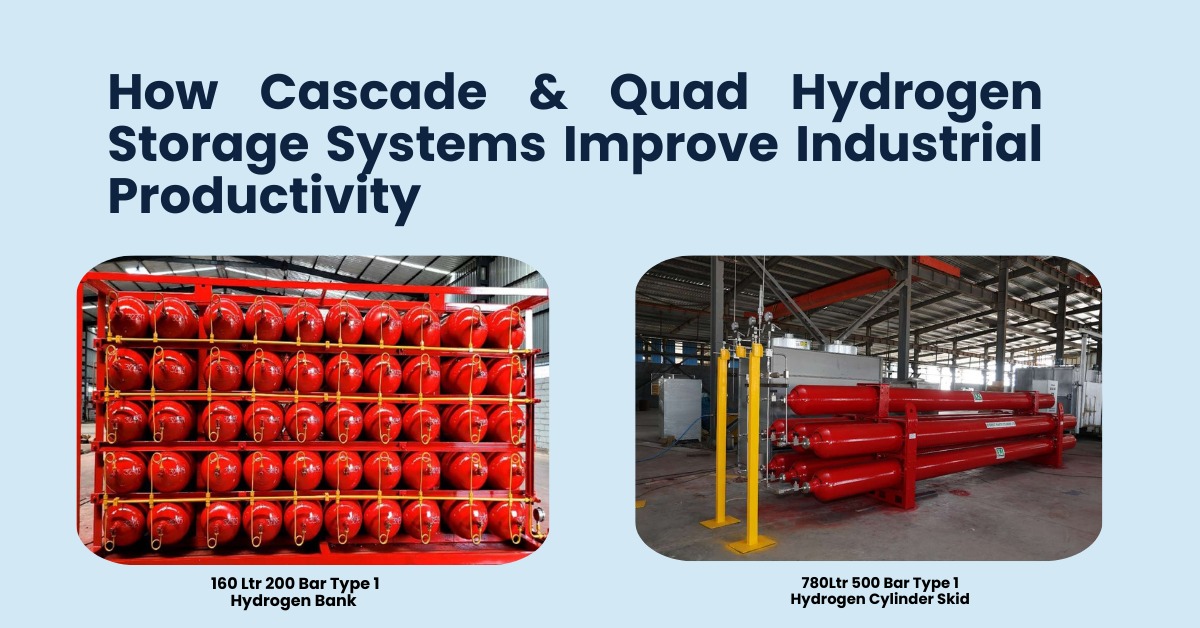
A cascade hydrogen storage system consists of multiple storage banks arranged at different pressure levels (typically 200/350/up to 700 bar). Hydrogen is dispensed sequentially from the lowest suitable pressure bank, ensuring maximum utilization of stored gas before switching to higher-pressure cylinders.
Quad Storage System
A quad system integrates four high-pressure cylinders into a single, compact module. These are often used as building blocks within cascade arrangements, offering high storage density, improved safety, and easier handling.
Together, cascade and quad configurations deliver efficient pressure management, modular expansion, and operational flexibility—key drivers of industrial performance.
Why Traditional Storage Limits Industrial Productivity
Conventional single-bank storage systems face several operational challenges:
- Frequent downtime due to inefficient pressure usage
- Higher energy consumption from repeated compression cycles
- Incomplete cylinder utilization, increasing hydrogen wastage
- Longer refueling or process delays, impacting output
In high-demand industrial environments, these inefficiencies directly translate into lost production time and higher operating costs.
How Cascade & Quad Systems Improve Productivity
Optimized Hydrogen Utilization
Cascade systems ensure hydrogen is drawn from the most suitable pressure level, allowing typically 15–25% better gas utilization compared to single-bank setups (based on field pilots). This minimizes residual pressure losses and reduces refilling frequency.
Faster Refueling & Process Continuity
By maintaining optimal pressure availability, cascade systems enable:
- Quicker hydrogen dispensing
- Stable supply to burners, fuel cells, and reactors
- Reduced equipment idle time
This is particularly valuable in continuous industrial processes where interruptions are costly.
Reduced Energy & Compression Costs
Efficient pressure management lowers the need for high-power recompression, resulting in:
- Lower electricity consumption
- Extended compressor life
- Reduced maintenance downtime
Over time, this leads to measurable productivity gains and cost savings.
Modular & Scalable Design
Quad cylinders allow easy system expansion as hydrogen demand grows. Industries can:
- Start small and scale gradually
- Add storage capacity without major infrastructure changes
- Align investments with production growth
This flexibility supports faster project deployment and operational agility.
Industrial Applications Driving Efficiency
Manufacturing & Process Industries
Steel, glass, electronics, and chemical plants benefit from:
- Continuous hydrogen availability
- Stable pressure for precision processes
- Reduced production interruptions
Hydrogen Mobility & Refueling Stations
Cascade-quad systems enable:
- Faster bus, truck, and forklift refueling
- Higher daily vehicle throughput
- Improved station utilization
Energy & Power Systems
Fuel cells and backup power units rely on consistent hydrogen supply. Cascade systems ensure:
- Reliable power output
- Minimal startup delays
- Improved system uptime
R&D and Testing Facilities
Laboratories and pilot plants benefit from precise pressure control and safer modular storage, supporting uninterrupted experimentation and innovation.
Safety, Compliance & Operational Reliability
Modern cascade and quad storage systems are designed in line with:
- Chief Controller of Explosives (PESO) and BIS guidelines in India
- ISO 19880-1 for gaseous hydrogen fueling
- Integrated safety valves, pressure relief devices, and isolation systems
Modular layouts also improve safety by localizing risks and simplifying inspections—boosting operational confidence and workforce productivity.
Supporting India’s Hydrogen Growth
As India works toward 5 MMT of green hydrogen production by 2030 under NGHM’s expanded 2026 pilots (e.g., NTPC Odisha, IoCL Leh), downstream infrastructure will play a decisive role. Cascade and quad storage systems:
- Complement decentralized and on-site hydrogen production
- Enable faster adoption across MSMEs and industrial clusters
- Reduce dependence on oversized centralized storage
Their efficiency-driven design aligns well with India’s cost-sensitive and scalability-focused industrial landscape.
The Road Ahead
Cascade and quad hydrogen storage systems are no longer optional upgrades—they are productivity enablers. By maximizing hydrogen utilization, minimizing downtime, and ensuring consistent supply, these systems directly improve industrial efficiency and competitiveness.
As hydrogen transitions from pilot projects to mainstream industrial fuel, adopting intelligent storage solutions will define operational success. For industries aiming to stay ahead in the clean energy transition, cascade and quad systems offer a clear path to higher productivity, lower costs, and sustainable growth.