Introduction
India’s clean mobility transition is accelerating rapidly as the country looks beyond conventional fuels to meet its net-zero and energy security goals. While electric mobility dominates passenger transport, hydrogen is emerging as the preferred clean fuel for heavy-duty mobility, including buses, trucks, railways, and long-haul logistics.
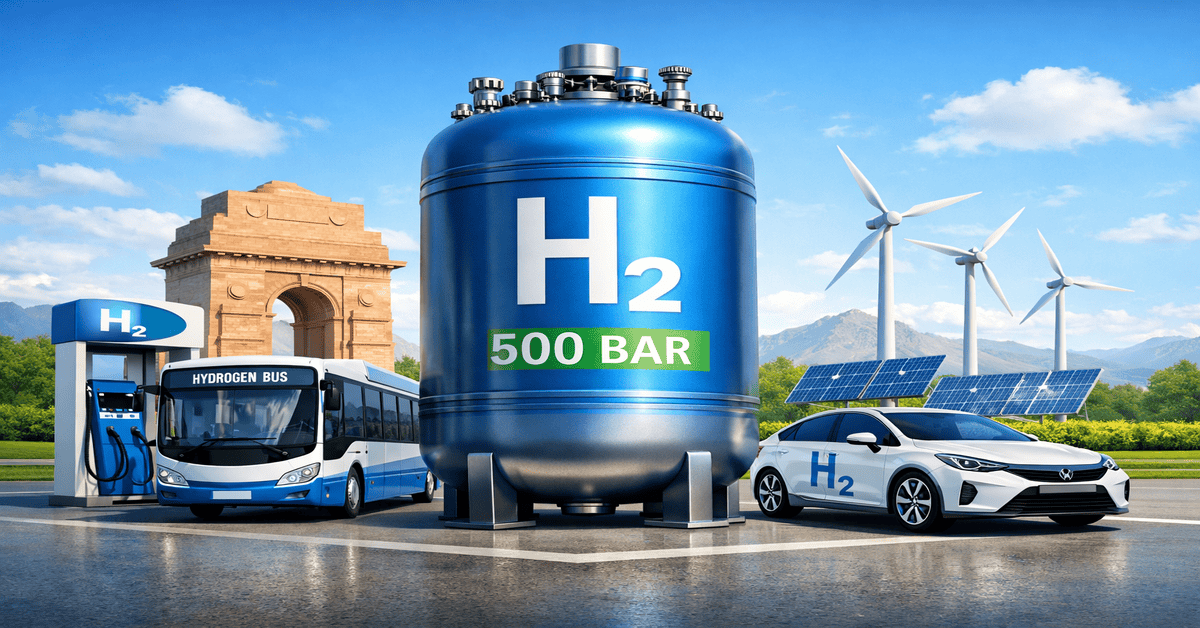
A key requirement for hydrogen mobility is high-pressure storage, and among the most important benchmarks is 500 bar hydrogen storage. This storage level enables higher onboard capacity, faster refuelling, and scalable infrastructure—making it a critical enabler for India’s growing hydrogen transport ecosystem.
As India advances under the National Green Hydrogen Mission**, with its 5 MMT green hydrogen target by 2030 (potentially extending to 2032 per recent assessments)**, 500 bar storage systems will play a foundational role in building a reliable and efficient hydrogen mobility network.
Understanding 500 Bar Hydrogen Storage
Hydrogen gas has a very low density at atmospheric pressure, which makes compression essential for practical mobility applications. 500 bar storage refers to hydrogen being compressed and stored at 500 times atmospheric pressure (often 500-550 bar in cascades), allowing significantly more hydrogen to be stored in compact volumes.
Why High Pressure Matters in Mobility
- Higher driving range for hydrogen vehicles
- Reduced cylinder size and weight constraints
- Faster dispensing at refuelling stations
- Improved infrastructure efficiency
500 bar is widely adopted as a practical standard for industrial transport and clean mobility deployments.
Why 500 Bar Storage Is Critical for Clean Mobility
Enabling Long-Range Heavy-Duty Transport
Hydrogen-powered trucks and buses require high onboard fuel capacity. Compared to lower-pressure systems, 500 bar storage provides:
- Greater hydrogen density
- Longer operating hours per refuel
- Reduced downtime in logistics operations
This makes it ideal for India’s freight corridors and intercity transport routes.
Supporting Fast Refuelling Infrastructure
Unlike battery charging, hydrogen refuelling can be completed in minutes—but only when storage pressure is sufficiently high.
500 bar cascade systems enable:
- Rapid dispensing to vehicles
- Stable pressure management
- Higher station throughput per day
This is essential for fleet-based operations such as city buses and commercial trucking.
Improving Energy Efficiency and Storage Utilization
Higher-pressure storage ensures better utilization of hydrogen across refuelling cycles. With proper cascade arrangements, 500 bar systems reduce residual losses and optimize gas delivery, improving overall infrastructure efficiency (typically 15-25% better than lower pressures in pilots).
Industries and mobility hubs benefit through:
- Lower compression costs
- Reduced hydrogen wastage
- Improved productivity at stations.
Aligning with India’s Hydrogen Mobility Roadmap
India’s hydrogen mobility ecosystem is expanding through pilots and deployments across:
- Hydrogen buses in Delhi NCR (e.g., Greater Noida-Delhi-Agra) and Gujarat (e.g., Ahmedabad routes)
- Hydrogen truck trials in logistics clusters
- Hydrogen-powered trains under Indian Railways
- Port-based hydrogen fuel initiatives
500 bar storage forms the backbone of these projects by enabling scalable and safe fuel supply.
Key Applications of 500 Bar Storage in India
Hydrogen Refuelling Stations
500 bar storage banks are critical for dispensing hydrogen efficiently to buses, trucks, and forklifts.
They ensure:
- Continuous availability
- Faster refuelling cycles
- Better station economics
Heavy-Duty Mobility Fleets
Commercial fleets require high-pressure storage for uninterrupted operations, especially in sectors like:
- Mining and construction transport
- Long-haul trucking
- Public transit systems
Industrial Mobility and Material Handling
Hydrogen forklifts and industrial vehicles benefit from compact, high-pressure storage that allows round-the-clock performance without long charging times.
Safety and Regulatory Compliance
High-pressure hydrogen storage must follow strict safety standards. In India, systems are regulated under:
- PESO guidelines for compressed hydrogen storage
- BIS cylinder and valve standards
- ISO 19880**-1** fueling station safety frameworks
Modern 500 bar systems integrate:
- Pressure relief devices
- Leak detection sensors
- Automated isolation valves
- Modular skid-based safety layouts
These features ensure safe adoption at scale.
Challenges and the Path Forward
While 500 bar storage is essential, challenges remain:
- High initial infrastructure cost
- Need for advanced materials and manufacturing
- Skilled workforce for handling high-pressure systems
However, India’s push for domestic manufacturing under PLI schemes and hydrogen infrastructure incentives will accelerate cost reduction and deployment.
Innovations in:
- Type-IV composite cylinders
- Smart cascade control systems
- Modular storage skids
are making 500 bar solutions more accessible for mobility applications.
The Road Ahead
500 bar hydrogen storage is not just a technical requirement—it is a strategic pillar for India’s clean mobility future. By enabling long-range transport, fast refuelling, and scalable infrastructure, it supports hydrogen’s role in decarbonising heavy-duty mobility.
As India progresses toward its target of 5 MMT green hydrogen production by 2030, high-pressure storage systems will be essential to unlock hydrogen’s full potential in transport, logistics, and industrial mobility.
500 bar storage is the bridge between hydrogen production and real-world clean mobility adoption—powering the next era of sustainable transportation.