



Introduction
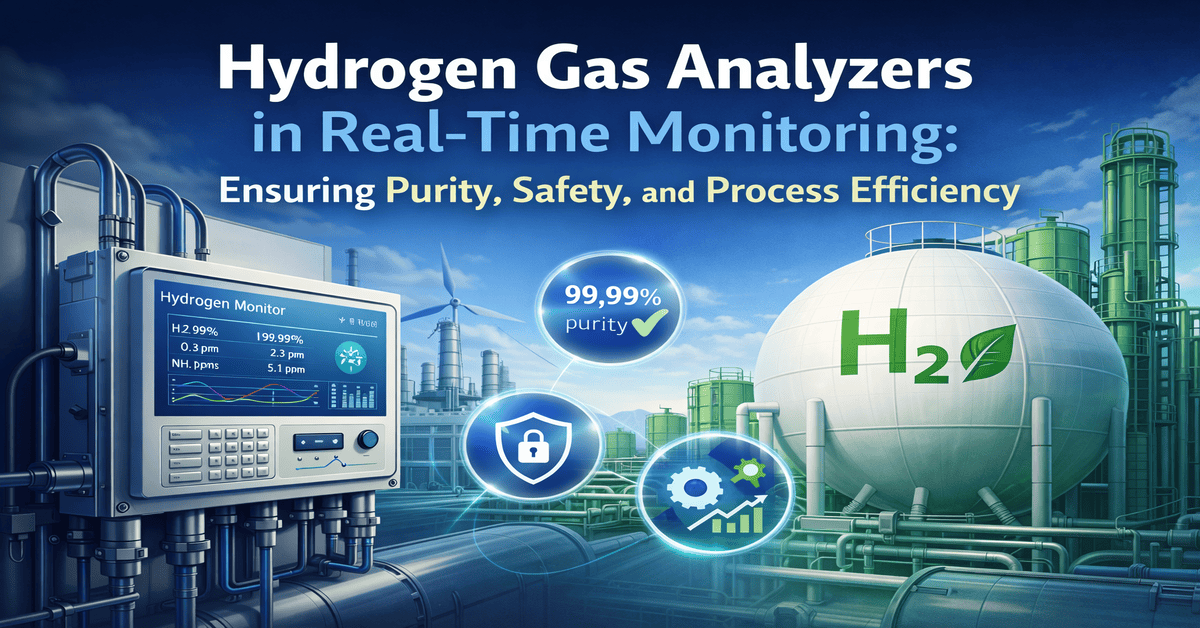
As industries increasingly adopt hydrogen for energy production, manufacturing, and clean power applications, precise gas monitoring has become mission-critical. Hydrogen’s high flammability and sensitivity to impurities demand continuous oversight to ensure both safety and performance.
Hydrogen gas analyzers deliver real-time monitoring that maintains purity, detects leaks instantly, and optimizes operational efficiency across the hydrogen value chain.
What Are Hydrogen Gas Analyzers?
These specialized instruments measure hydrogen concentration and purity in gas mixtures, providing continuous data for process control and safety.
Primary Applications:
- Refineries & petrochemical plants
- Power generation & fuel cells
- Semiconductor manufacturing
- Hydrogen production/storage systems
Why Real-Time Monitoring Matters
1. Gas Purity Assurance
Fuel cells and electronics require 99.999%+ purity. Even ppm-level impurities degrade performance. Real-time analysis maintains strict quality standards.
2. Enhanced Safety
Hydrogen’s wide flammability range (4-75% in air) demands instant leak detection. Analyzers trigger alarms before concentrations reach dangerous levels.
3. Process Optimization
Continuous data enables precise flow control, reduces waste, and maintains production consistency.
Core Technologies in Hydrogen Gas Analyzers
|
Technology |
Principle |
Best For |
|
Thermal Conductivity (TCD) |
Measures heat transfer differences |
General concentration monitoring |
|
Electrochemical |
Chemical reaction generates current |
Safety & leak detection |
|
Gas Chromatography (GC) |
Separates & analyzes gas components |
Laboratory-grade purity analysis |
|
Tunable Diode Laser (TDL) |
Laser absorption spectroscopy |
High-precision industrial use |
Key Benefits
- Immediate Insights: Real-time data for rapid response
- Risk Prevention: Early detection prevents incidents
- Quality Control: Consistent purity meets specs
- Cost Savings: Less downtime, optimized processes
- Compliance: Meets PESO, ISO, and safety standards
Industry Applications
Hydrogen Production: Monitor electrolyzer output purity (electrolysis/reforming)
Power Generation: Generator cooling systems, turbine monitoring
Oil & Gas: Refinery hydrotreating, cracking processes
Electronics: Ultra-pure H₂ for wafer production, CVD processes
Selection Criteria for Hydrogen Gas Analyzers
- Measurement Range: 0-100% H₂ or trace ppm detection
- Response Time: Seconds for safety, minutes for process
- Environmental Specs: IP65+ rating, -20°C to 60°C operation
- Calibration: Auto-calibration vs. manual frequency
- Integration: 4-20mA, Modbus, or PLC compatibility
Implementation Best Practices
- Strategic Placement: Install at compressors, storage, dispensers, and vents
- Regular Calibration: Quarterly validation with certified gas standards
- System Integration: Connect to SCADA, DCS, and emergency shutdowns
- Personnel Training: Safety protocols + analyzer operation
- Data Logging: 12+ months retention for compliance audits
Common Challenges & Solutions
|
Challenge |
Solution |
|
High upfront cost |
Modular systems scale with needs |
|
Maintenance in harsh environments |
IP67 enclosures + remote diagnostics |
|
Sensor drift over time |
Auto-zero + predictive maintenance |
|
Legacy system integration |
Standard protocols (Modbus/HART) |
Conclusion
Hydrogen gas analyzers represent essential infrastructure for the growing hydrogen economy. They deliver the precision, responsiveness, and reliability needed to safely scale hydrogen applications while maintaining operational excellence.
From production to end-use, real-time monitoring protects assets, ensures compliance, and unlocks efficiency gains. The right analyzer investment positions your operations for sustainable growth in the clean energy era.