




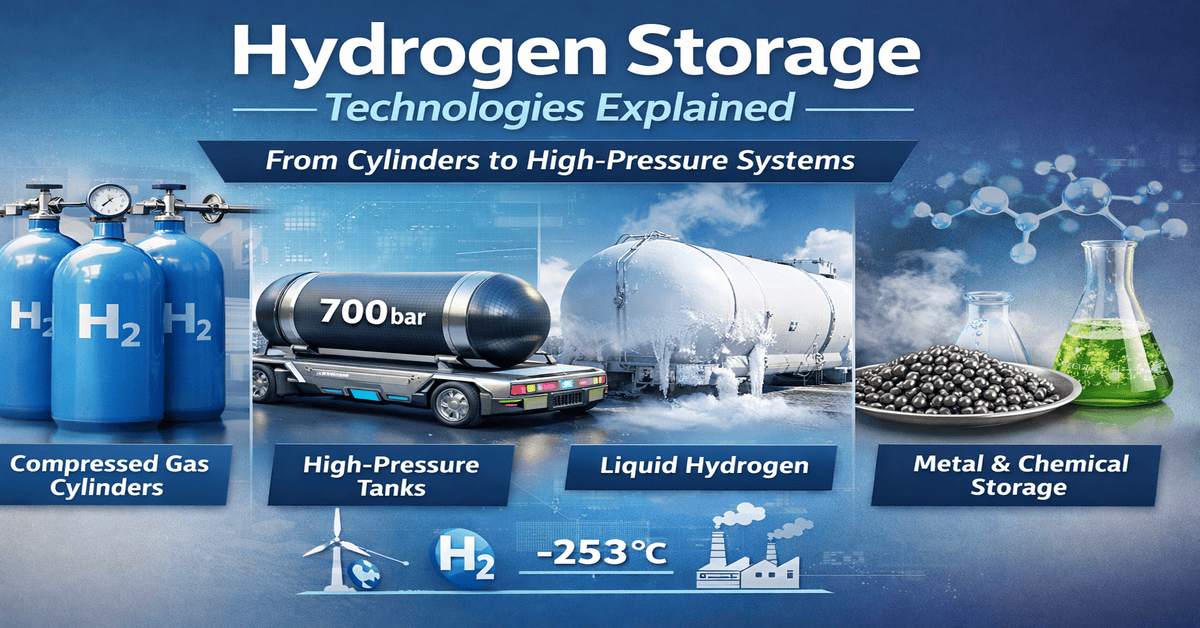
Introduction
As industries accelerate toward decarbonization, hydrogen is emerging as a key clean energy carrier. From refining and chemicals to mobility and power generation, hydrogen is enabling low-carbon transitions across sectors. However, one critical challenge remains: how to store hydrogen safely, efficiently, and economically.
Due to its low density and high flammability, hydrogen requires specialized storage technologies. In this blog, we’ll explore the major hydrogen storage methods—from conventional cylinders to advanced high-pressure systems—and understand their applications, advantages, and limitations.
This cutaway shows a Type IV composite tank used in high-pressure systems, featuring carbon fiber wraps for strength and lightweight design.
Why Hydrogen Storage Matters
Hydrogen storage is not just a technical requirement—it directly impacts:
- Safety and risk management
- Transportation feasibility
- Energy efficiency
- System costs
Efficient storage ensures that hydrogen can be produced, transported, and used reliably across various industrial and commercial applications.
1. Compressed Hydrogen Gas Storage (Cylinders)
Overview
The most common and widely used method is storing hydrogen as a compressed gas in cylinders (typically Type I/II steel/composite for lower pressures).
How It Works
Hydrogen gas is compressed to pressures typically between 150-500 bar for standard applications and stored in high-strength cylinders made of steel or composite materials.
Key Features
- Simple and mature technology
- Widely available infrastructure
- Suitable for small-scale and portable applications
Applications
- Laboratories
- Industrial gas supply
- Backup energy systems
Limitations
- Low energy density
- Requires large storage volume
- Safety concerns at high pressure
2. High-Pressure Hydrogen Storage Systems
Overview
For applications requiring higher energy density—such as fuel cell vehicles—hydrogen is stored at much higher pressures.
How It Works
Hydrogen is compressed up to 350–700 bar and stored in advanced composite tanks (Type I or Type IV).
Key Features
- Higher storage capacity in smaller space
- Lightweight composite materials
- Designed for mobility applications
Applications
- Hydrogen fuel cell vehicles
- Transportation and mobility sector
- On-site industrial storage
Limitations
- High cost of compression and tank materials
- Requires advanced safety systems (e.g., TPRD for thermal pressure relief)
- Energy loss during compression
3. Liquid Hydrogen Storage
Overview
Hydrogen can also be stored as a liquid by cooling it to extremely low temperatures.
How It Works
Hydrogen is liquefied at -253°C (20.28 K at atmospheric pressure) and stored in cryogenic tanks.
Key Features
- Much higher energy density than gas
- Suitable for bulk storage and long-distance transport
Applications
- Aerospace industry
- Large-scale hydrogen transport
- Energy export/import
Limitations
- High energy consumption for liquefaction
- Boil-off losses (due to heat ingress)
Complex insulation requirements
4. Metal Hydride Storage
Overview
An advanced method where hydrogen is stored in solid materials.
How It Works
Hydrogen is absorbed into metals or alloys (e.g., TiFe, LaNi5, MgH2), forming metal hydrides. It is released when heated.
Key Features
- High safety (low pressure)
- Compact storage
- Controlled hydrogen release
Applications
- Stationary energy storage
- Backup power systems
Limitations
- Heavy materials
- Slow charging/discharging
- High cost
VJ industries is planning to provide Metal hydride storage solution.
5. Chemical Hydrogen Storage
Overview
Hydrogen is stored in chemical compounds and released through chemical reactions.
Examples
- Ammonia (NH₃)
- Liquid organic hydrogen carriers (LOHCs) (e.g., dibenzyltoluene)
Key Features - Easier storage and transport
- Can use existing infrastructure
Applications - Hydrogen transport over long distances
- Industrial energy systems
Limitations - Requires conversion processes
- Energy losses during release
Safety Considerations in Hydrogen Storage
Regardless of the storage method, safety is critical. Key precautions include:
- Leak detection systems
- Proper ventilation
- Pressure monitoring
- Use of certified storage tanks (per ISO 19880, NFPA 2)
- Real-time hydrogen monitoring systems play a crucial role in preventing leaks and ensuring operational safety.
Choosing the Right Hydrogen Storage Technology
The ideal storage method depends on:
- Application (mobility, industrial, stationary)
- Required storage capacity
- Cost constraints
- Safety requirements
For example: - Cylinders → best for small-scale use
- High-pressure tanks → ideal for mobility
- Liquid hydrogen → suitable for bulk transport
- Hydrides/chemical storage → emerging solutions for specialized use
Future Trends in Hydrogen Storage
The hydrogen economy is evolving rapidly, and storage technologies are advancing to meet growing demand. Key trends include:
- Development of lightweight composite tanks
- Improved cryogenic storage systems
- Advanced solid-state storage materials
- Integration with renewable energy systems
These innovations will make hydrogen storage more efficient, safe, and commercially viable.
Conclusion
Hydrogen storage is a foundational element of the clean energy transition. From traditional cylinders to advanced high-pressure and cryogenic systems, each technology offers unique benefits and trade-offs.
As industries scale up hydrogen adoption, choosing the right storage solution—and ensuring safety through proper monitoring and system design—will be critical to long-term success.

