



Introduction
As the hydrogen economy expands, safety, reliability, and efficiency have become top priorities across production plants, storage sites, transport systems, and refueling stations. Hydrogen assets often operate under demanding conditions, so they need continuous monitoring and timely maintenance.
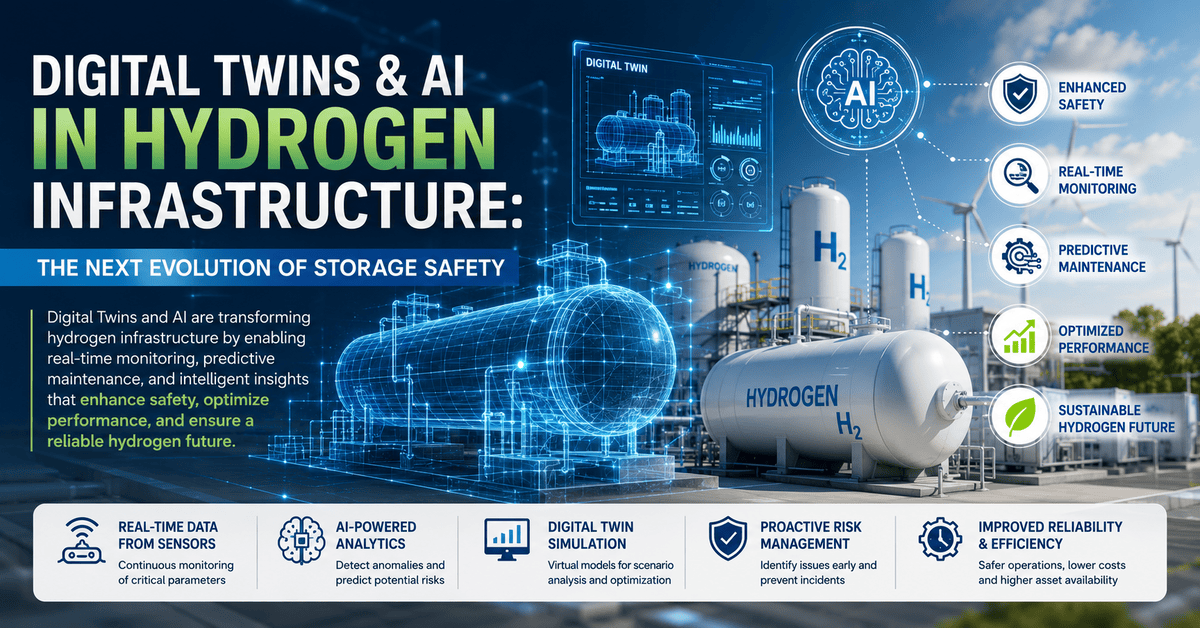
Digital twins and artificial intelligence (AI) are emerging as powerful tools for improving how hydrogen infrastructure is designed, monitored, and managed. By combining real-time sensor data, virtual asset models, and predictive analytics, these technologies can help operators detect issues earlier, optimize performance, and improve safety.
What Is a Digital Twin?
A digital twin is a virtual representation of a physical asset, process, or system. It uses data from sensors and operational systems to mirror the condition and behavior of real equipment in near real time.
In hydrogen infrastructure, digital twins can be applied to:
- Hydrogen storage cylinders.
- Storage tanks.
- Pipeline networks.
- Compressors.
- Pressure regulators.
- Electrolyzers.
- Hydrogen refueling stations.
The Role of AI
AI complements digital twins by analyzing large volumes of operational data and detecting patterns that may not be obvious to human operators. In hydrogen systems, AI can support anomaly detection, predictive maintenance, leak risk monitoring, and operational optimization.
Together, AI and digital twins create a smarter monitoring environment that can improve reliability and reduce safety risks.
Why Storage Safety Matters
Hydrogen is a clean and versatile energy carrier, but its storage requires specialized systems because of its flammability, high diffusivity, and use in high-pressure or cryogenic conditions. Safety concerns include leak detection, pressure management, temperature control, and material degradation.
Traditional inspection methods often rely on periodic checks, which may miss problems that develop between inspections. Digital twins and AI help close that gap by enabling more continuous oversight.
How AI and Digital Twins Help
- Real-time monitoring. Sensors continuously collect data on pressure, temperature, flow, and equipment status, while the digital twin visualizes system behavior.
- Predictive maintenance. AI can identify signs of wear or abnormal operation before failures occur, helping reduce downtime and maintenance costs.
- Early leak detection. Hydrogen monitoring systems can use sensor data and AI-based analysis to detect abnormal pressure changes, gas concentration shifts, and unusual flow behavior.
- Structural health monitoring. Digital twins can help track stress, fatigue, and degradation in storage systems and related components.
- Emergency simulation. Operators can test failure scenarios, pressure spikes, and shutdown procedures in a virtual environment before applying them to the real system.
- Optimized storage performance. AI can help balance pressure, improve compressor operation, and reduce energy use while maintaining safe operating conditions.
- Compliance support. Digital twin systems can support record-keeping, reporting, and operational transparency for inspections and audits.
Benefits
Organizations that adopt these technologies can gain:
- Better storage safety.
- Real-time visibility.
- Lower maintenance costs.
- Higher reliability.
- Reduced downtime.
- Improved decision-making.
- Better asset resilience.
Challenges
Adoption still faces several hurdles, including high initial costs, data-quality requirements, cybersecurity concerns, and the need for skilled teams. These issues can slow deployment even when the technology is technically ready.
Future Outlook
As hydrogen infrastructure grows, digital twins and AI are likely to play a larger role in safety management and operational optimization. Future systems may include more autonomous monitoring, advanced predictive analytics, and tighter integration with smart energy networks.
Conclusion
Digital twins and AI are reshaping hydrogen infrastructure by enabling continuous monitoring, predictive maintenance, and better decision-making. Used well, they can help operators detect risks earlier, improve efficiency, and strengthen storage safety.
As hydrogen adoption expands, these technologies will likely become increasingly important for building safe, efficient, and future-ready infrastructure.
References
- https://research.tudelft.nl/en/publications/digital-twin-implementation-of-hydrogen-energy-storage-for-energy/
- https://publications.aiche.org/cep/2026/april/design-and-optimization-green-hydrogen-processes-using-digital-twins?
- https://www.sciencedirect.com/science/article/abs/pii/S0973082626001353
- https://hydrogencouncil.com/