




Introduction
As countries accelerate efforts to cut carbon emissions and build cleaner transport systems, hydrogen is emerging as a promising fuel for heavy-duty mobility. While battery electric vehicles are gaining traction in passenger transport, hydrogen is attracting attention for trucks, buses, logistics fleets, and other long-distance applications where fast refueling and longer range matter most.
India is now actively testing this pathway through pilot projects under the National Green Hydrogen Mission. These efforts include hydrogen-powered buses and trucks, refueling stations, and route-based trials designed to assess how hydrogen corridors could support future freight and public transport needs.
Understanding Hydrogen Refueling Corridors
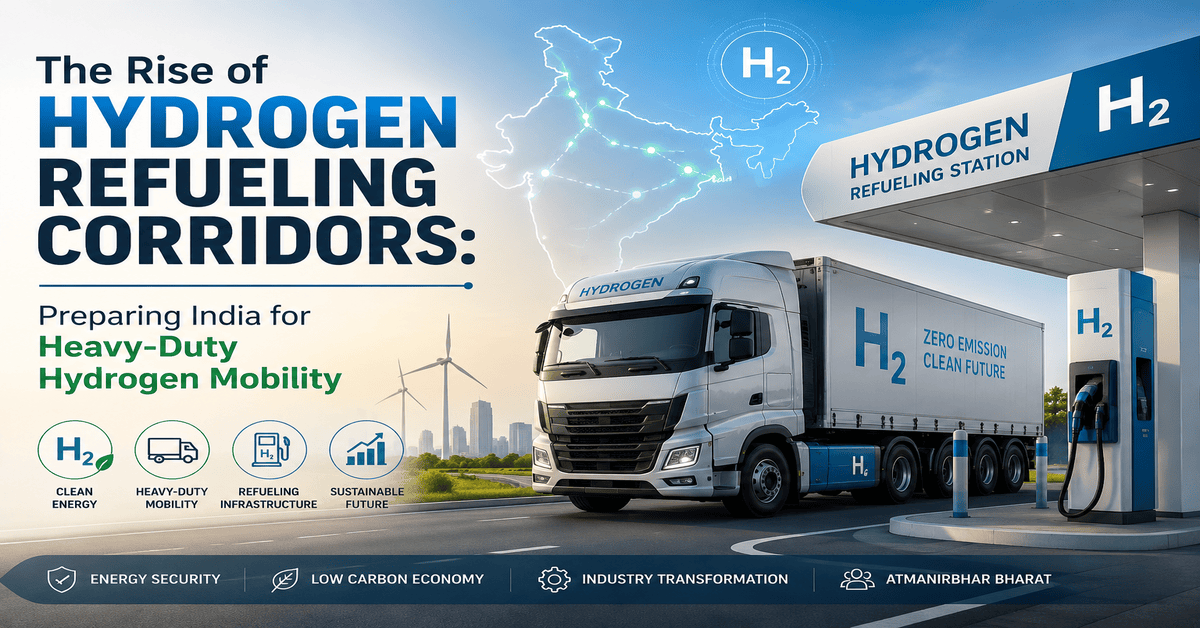
Hydrogen refueling corridors are planned transport routes equipped with hydrogen stations at strategic intervals. Their purpose is to allow hydrogen-powered vehicles to travel long distances with reliable access to fuel, similar to how conventional highway fuel stations support diesel and petrol vehicles.
These corridors are especially relevant for:
- Heavy commercial trucks.
- Public buses.
- Logistics fleets.
- Freight transport.
- Long-distance cargo movement.
A well-developed corridor network can help hydrogen vehicles operate more reliably across industrial and transport-heavy regions.
Why Heavy-Duty Transport Needs Hydrogen
Heavy-duty transport has different requirements from passenger mobility. Trucks and buses often cover long distances, carry large loads, and cannot afford extended downtime for charging. Hydrogen offers advantages in such use cases because refueling can be faster than charging large battery packs, and fuel-cell systems may be better suited to preserving payload capacity.
For this reason, hydrogen is being explored as a practical solution for segments where batteries face limitations in range, charging time, or weight.
India’s Hydrogen Mobility Push
India’s push toward hydrogen mobility is part of a broader clean-energy strategy under the National Green Hydrogen Mission. In January 2024, the government announced five pilot projects for hydrogen buses and trucks across 10 routes, supported by 37 vehicles and 9 hydrogen refueling stations.
The trial routes include corridors such as:
- Greater Noida–Delhi–Agra.
- Bhubaneshwar–Konark–Puri.
- Ahmedabad–Vadodara–Surat.
- Sahibabad–Faridabad–Delhi.
- Pune–Mumbai.
- Jamshedpur–Kalinga Nagar.
- Thiruvananthapuram–Kochi.
- Kochi–Edappally.
- Jamnagar–Ahmedabad.
- NH-16 Visakhapatnam–Bayyavaram.
These pilots show that hydrogen corridors in India are already moving from concept to implementation.
Benefits of Hydrogen Corridors
Hydrogen refueling corridors can support long-distance mobility by reducing range anxiety for trucks and buses and improving route flexibility. They can also help fleet operators by lowering operational uncertainty and encouraging adoption of hydrogen vehicles.
They may also contribute to lower emissions, especially when hydrogen is produced from renewable power. In that case, fuel-cell vehicles emit only water vapor at the tailpipe and can support cleaner urban air and lower lifecycle carbon emissions.
Beyond transport, corridor development can stimulate infrastructure investment, technology development, manufacturing activity, and skilled employment in India’s clean-energy economy.
Challenges Ahead
Despite the promise, hydrogen corridors face important challenges. Building production, storage, transport, and refueling infrastructure requires major capital investment, and large-scale deployment depends on reliable hydrogen supply. Safety standards, regulation, and commercial viability also remain critical issues.
Because of these challenges, India’s current approach is still pilot-based rather than large-scale commercial rollout.
Future Outlook
The future of heavy-duty hydrogen mobility in India will depend on how quickly fuel costs fall, infrastructure expands, and vehicle performance improves. If pilot projects prove successful, hydrogen corridors could expand along major freight routes, logistics hubs, and industrial clusters.
As the ecosystem matures, hydrogen may become an important part of India’s long-term transport decarbonization strategy.
Conclusion
Hydrogen refueling corridors represent a significant step toward enabling heavy-duty hydrogen mobility in India. By supporting trucks, buses, and freight fleets on key routes, they can help reduce emissions, improve energy resilience, and build confidence in hydrogen transport.
India has already begun this journey through pilot corridors, refueling stations, and vehicle trials. The next phase will depend on scaling infrastructure, ensuring clean hydrogen supply, and proving that hydrogen mobility can work reliably in real-world transport operations.