



Introduction
India’s clean-energy transition is creating new opportunities not only for green hydrogen but also for one of its most important derivatives—green ammonia.
Green ammonia is produced using green hydrogen and nitrogen from the air. Unlike conventional ammonia, which is generally produced using fossil-fuel-based hydrogen, green ammonia can significantly reduce carbon emissions when renewable electricity powers the hydrogen production process.
For India, green ammonia has enormous potential. It can support the fertilizer industry, reduce dependence on imported fossil-based feedstocks, create new export opportunities, and potentially serve as a clean fuel for shipping and power generation.
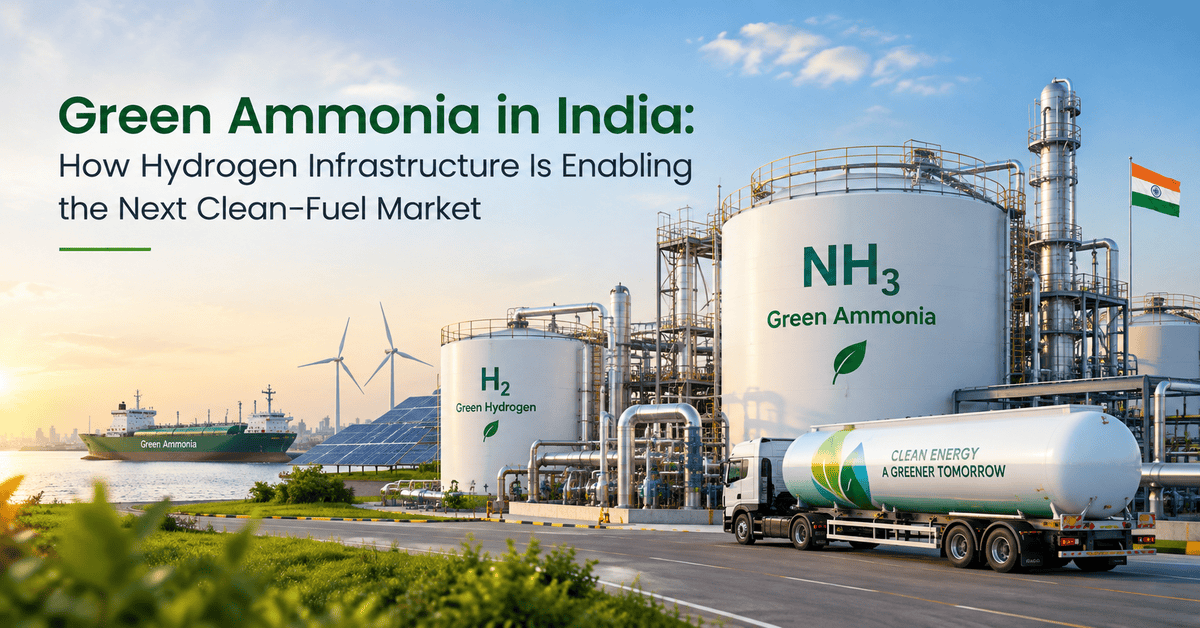
However, the growth of the green ammonia market depends on more than hydrogen production alone. A complete infrastructure ecosystem—including renewable energy, electrolyzers, hydrogen storage, compression, transportation, ammonia synthesis, storage terminals, and port infrastructure—is essential.
As India develops its hydrogen infrastructure, it is also laying the foundation for the next generation of clean-fuel markets.
What Is Green Ammonia?
Ammonia has the chemical formula NH₃ and consists of nitrogen and hydrogen. Traditional ammonia production typically relies on hydrogen produced from natural gas or other fossil fuels. Green ammonia replaces this conventional hydrogen with green hydrogen produced using renewable electricity.
The simplified production process is:
Renewable Energy → Electrolyzer → Green Hydrogen + Nitrogen → Ammonia Synthesis → Green Ammonia
The key difference lies in the source of hydrogen. When renewable energy is used to power electrolysis, the resulting ammonia can have a significantly lower carbon footprint than conventional ammonia.
Why Green Ammonia Matters to India
India is already one of the world’s major consumers of ammonia, particularly because of its large fertilizer industry. According to the National Green Hydrogen Mission framework, a significant share of India’s existing hydrogen consumption is linked to petroleum refining and ammonia production for fertilizers. This creates a major opportunity to replace fossil-based hydrogen with green hydrogen and green ammonia.
Green ammonia could help India in several ways:
- Decarbonizing fertilizer production
- Reducing dependence on imported fossil fuels
- Creating new clean-energy export opportunities
- Supporting renewable energy development
- Building domestic manufacturing capabilities
- Developing a hydrogen-based industrial ecosystem
How Hydrogen Infrastructure Enables Green Ammonia
Green ammonia cannot scale without a strong hydrogen infrastructure. Every stage of the hydrogen value chain plays an important role in ammonia production.
1. Renewable Energy Infrastructure
The first requirement for green ammonia is affordable renewable electricity. Electrolyzers require significant amounts of electricity to produce green hydrogen. India’s large solar and wind energy potential can provide an important advantage for green ammonia production.
Renewable energy infrastructure therefore forms the foundation of the entire value chain.
2. Electrolyzer Capacity
Electrolyzers use electricity to split water into hydrogen and oxygen. For large-scale green ammonia production, significant electrolyzer capacity is required.
India’s National Green Hydrogen Mission supports domestic electrolyzer manufacturing and green hydrogen production capacity. As of March 2026, the government reported that 3,000 MW per year of electrolyzer manufacturing capacity had been awarded to 15 companies under the Mission.
The growth of domestic electrolyzer manufacturing can help reduce technology dependence and support the expansion of green ammonia projects.
3. Hydrogen Storage and Compression
Hydrogen production and ammonia synthesis do not always operate under identical conditions. Storage systems can help balance hydrogen production with ammonia manufacturing requirements.
Hydrogen infrastructure may include:
- Compression systems
- High-pressure storage
- Pipelines
- Buffer storage
- Transport systems
Reliable storage and compression infrastructure can improve the flexibility and reliability of green ammonia plants.
4. Hydrogen Transportation Networks
In some cases, hydrogen production and ammonia production may be located close together. In others, hydrogen may need to be transported to industrial facilities.
India’s National Green Hydrogen Mission identifies pipelines, tankers, intermediate storage facilities, and last-mile distribution networks as important components of the hydrogen supply chain. As this infrastructure develops, it can support multiple hydrogen-based industries, including green ammonia.
From Green Hydrogen to Green Ammonia
Once green hydrogen is produced, it is combined with nitrogen to manufacture ammonia. The process generally involves:
Step 1: Hydrogen Production
Renewable electricity powers an electrolyzer to produce green hydrogen.
Step 2: Nitrogen Production
Nitrogen is separated from air using industrial air-separation technology.
Step 3: Ammonia Synthesis
Hydrogen and nitrogen are combined under controlled temperature and pressure conditions to produce ammonia.
The ammonia can then be stored, transported, consumed domestically, or exported.
Why Ammonia Could Become an Important Hydrogen Carrier
One of the biggest challenges with hydrogen is transportation. Hydrogen has a low volumetric energy density in gaseous form and requires specialized storage and transportation infrastructure.
Ammonia offers an alternative pathway. Because ammonia is already widely produced, transported, and traded globally, existing industrial and port infrastructure can potentially support the development of international hydrogen supply chains.
The International Energy Agency notes that ammonia is playing a major role in emerging low-emissions hydrogen trade and infrastructure, with ammonia terminals already operating globally and new projects continuing to develop. This makes green ammonia particularly attractive for countries like India that are targeting both domestic consumption and exports.
Green Ammonia and India’s Fertilizer Industry
The fertilizer sector is expected to become one of the most important early markets for green ammonia in India. Ammonia is a key ingredient in fertilizer production. Replacing fossil-based ammonia with green ammonia can help reduce emissions across the agricultural supply chain.
India has already made progress toward creating demand for green ammonia. In March 2026, the government announced that prices had been discovered for the production and supply of approximately 724,000 metric tonnes per annum of green ammonia to 13 fertilizer units across India under the National Green Hydrogen Mission.
This represents an important step from policy development toward actual commercial demand creation. The agreements, facilitated by SECI under the SIGHT Scheme, are signed for a tenure of 10 years and are expected to generate foreign exchange savings of approximately $2.5 billion over the agreement period.
Green Ammonia as a Maritime Fuel
Shipping is another potential growth area for green ammonia. The maritime industry is under increasing pressure to reduce carbon emissions, and alternative fuels are becoming an important part of long-term decarbonization strategies.
Green ammonia is being explored because it:
- Contains no carbon molecules
- Can potentially reduce lifecycle emissions when produced using renewable hydrogen
- Has established global transportation infrastructure
- Can be stored in liquid form under suitable conditions
- Could support long-distance maritime operations
India’s National Green Hydrogen Mission also includes pilot projects for the use of green hydrogen in the shipping sector, highlighting the growing importance of hydrogen-based fuels in maritime decarbonization. The Mission specifically targets retrofitting at least two ships to run on green hydrogen or derived fuels by 2027, and setting up green ammonia bunkering facilities at least at one port by 2025, expanding to all major ports by 2035.
The Role of Ports and Export Infrastructure
Ports could become a major part of India’s green ammonia ecosystem. India has a strategic geographic advantage because of its access to international shipping routes and large renewable-energy potential.
For green ammonia exports, infrastructure may include:
- Ammonia production facilities
- Storage terminals
- Port-based storage tanks
- Loading and unloading facilities
- Specialized shipping infrastructure
- Safety and monitoring systems
The National Green Hydrogen Mission specifically recognizes export opportunities for green hydrogen and its derivatives and supports infrastructure development for supply chains and hydrogen hubs. India’s demand-creation strategy also highlights the potential for international markets to become an important source of future demand for green hydrogen and green ammonia.
Green Ammonia and Energy Security
Green ammonia can contribute to India’s long-term energy security. Today, many industrial sectors depend on imported fossil fuels and fossil-based feedstocks.
Expanding domestic green hydrogen and ammonia production could help:
- Reduce import dependence
- Diversify energy sources
- Strengthen domestic industrial supply chains
- Support renewable-energy expansion
- Improve resilience against global fuel price volatility
The National Green Hydrogen Mission specifically aims to make India a global hub for the production, use, and export of green hydrogen and its derivatives while reducing dependence on fossil-fuel imports.
Key Infrastructure Challenges
Despite its strong potential, green ammonia development faces several infrastructure challenges.
High Production Costs
Green hydrogen remains more expensive than conventional fossil-based hydrogen in many cases. Reducing renewable electricity and electrolyzer costs will be essential.
Large Renewable Energy Requirements
Producing green hydrogen at scale requires substantial renewable electricity capacity. Grid connectivity, energy storage, and reliable renewable supply will play important roles.
Storage and Transportation Infrastructure
Both hydrogen and ammonia require specialized storage, handling, and transportation systems. Large-scale deployment will require investment in:
- Hydrogen compression
- Storage facilities
- Pipelines and transport systems
- Ammonia storage tanks
- Port terminals
- Safety infrastructure
Safety and Regulatory Frameworks
Ammonia is a well-known industrial chemical but requires strict handling and safety procedures. Clear regulations, technical standards, trained personnel, and emergency response systems will be necessary as the market expands.
Building Reliable Demand
Large-scale projects require long-term buyers. India’s green ammonia demand aggregation efforts are important because they help create predictable demand and improve investor confidence. The National Green Hydrogen Mission explicitly supports demand creation through green hydrogen and derivative products such as green ammonia.
India’s Growing Green Ammonia Ecosystem
India’s green ammonia market is beginning to move from concept to implementation. Recent developments include:
- Incentives for electrolyzer manufacturing
- Green hydrogen production capacity awards
- Demand aggregation for green ammonia
- Supply agreements with fertilizer-sector consumers
- Development of hydrogen hubs
- Support for port and export infrastructure
- Research and innovation programme
The government reported in March 2026 that green ammonia prices had been discovered for approximately 724,000 MTPA of supply to 13 fertilizer units, demonstrating significant progress in market creation.
These developments suggest that green ammonia could become one of the first major commercial markets built around India’s green hydrogen ecosystem.
The Future of Green Ammonia in India
The next phase of India’s green ammonia industry could focus on integrating the entire value chain.
Future developments may include:
- Larger renewable-powered hydrogen plants
- Integrated green ammonia production facilities
- Domestic electrolyzer manufacturing
- Hydrogen storage and compression systems
- Port-based ammonia terminals
- Dedicated export corridors
- Green ammonia bunkering infrastructure
- Fertilizer-sector adoption
- International supply agreements
The International Energy Agency’s latest analysis also highlights the growing importance of ammonia in international low-emissions hydrogen trade, particularly through long-term contracts and port infrastructure.
Conclusion
Green ammonia could become one of the most important clean-fuel markets emerging from India’s green hydrogen economy. But its success will depend on much more than ammonia production technology. A complete infrastructure ecosystem—covering renewable energy, electrolyzers, hydrogen storage, compression, transportation, ammonia synthesis, storage terminals, and ports—will be essential.
India is already taking important steps through the National Green Hydrogen Mission, including support for hydrogen production, domestic manufacturing, infrastructure development, demand creation, and green ammonia procurement.
As hydrogen infrastructure expands, it will create the foundation needed to connect renewable energy with industrial demand, fertilizer production, shipping, and international markets.
Green ammonia is not just a derivative of green hydrogen—it could become one of the key pathways through which India’s hydrogen economy reaches commercial scale and global markets.