



Introduction
India’s green hydrogen ecosystem is moving beyond hydrogen production toward the development of the infrastructure needed to store, transport, compress, and dispense hydrogen safely and efficiently.
This infrastructure will be particularly important for hydrogen-powered mobility. Under the National Green Hydrogen Mission (NGHM), India is supporting mobility pilot projects and the development of supply chains, including intermediate storage, transportation, and last-mile distribution infrastructure.
A hydrogen refueling station is more than simply a “fuel pump.” It is an integrated system involving hydrogen supply, compression, high-pressure storage, cooling, dispensing equipment, safety systems, and monitoring technologies.
Understanding these components is essential as India prepares for the wider adoption of hydrogen-powered buses, trucks, commercial vehicles, and other heavy-duty applications.
What Is Hydrogen Refueling Infrastructure?
Hydrogen refueling infrastructure is the network of equipment and facilities required to deliver hydrogen from its production or supply point to a vehicle.
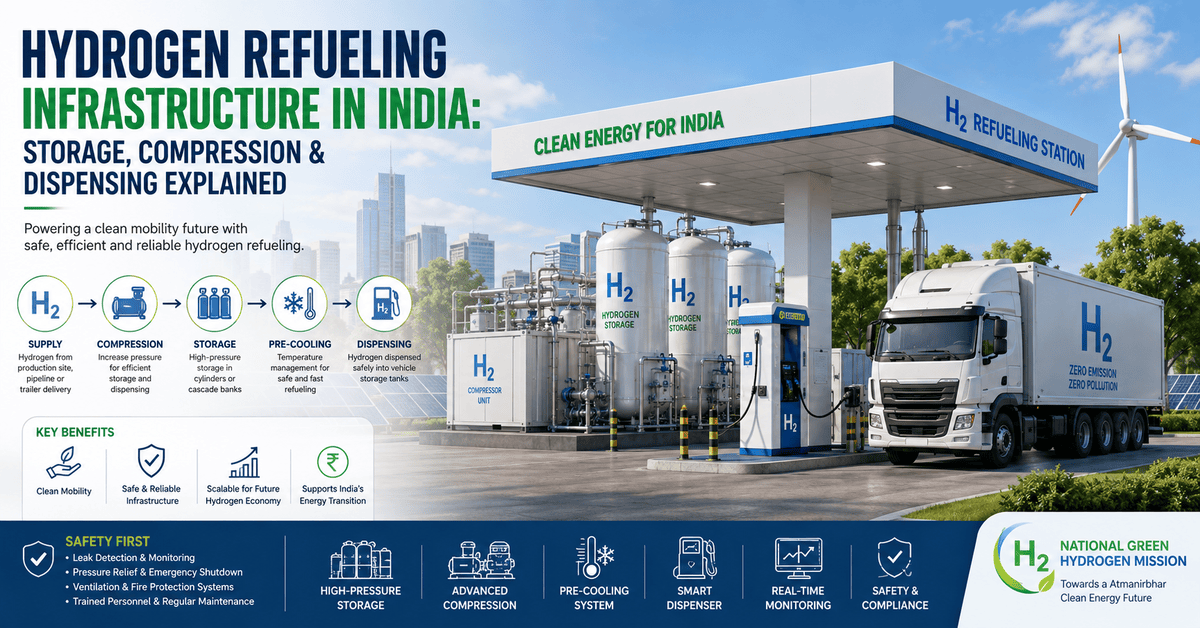
A simplified hydrogen refueling process looks like this:
Hydrogen Supply → Compression → High-Pressure Storage → Pre-Cooling → Dispensing → Vehicle
Each stage has a specific role in ensuring that hydrogen reaches the vehicle at the required pressure, temperature, and flow rate.
India’s National Green Hydrogen Mission specifically identifies infrastructure for transporting and distributing hydrogen—including pipelines, tankers, intermediate storage facilities, and last-mile distribution—as an important part of the hydrogen ecosystem.
1. Hydrogen Supply
The first step is getting hydrogen to the refueling station. Hydrogen can be supplied through different methods, depending on the location and scale of the station.
Common supply methods include:
- Hydrogen produced onsite through electrolysis
- Hydrogen delivered by tube trailers
- Pipeline-based hydrogen supply
- Hydrogen supplied from centralized production facilities
For green hydrogen mobility, onsite electrolysis can be particularly attractive where renewable electricity and water are available. Centralized production with road or pipeline transportation may be more suitable for larger networks.
The right model depends on hydrogen demand, distance from production facilities, infrastructure availability, and overall project economics.
2. Hydrogen Compression
Compression is one of the most important parts of a hydrogen refueling station. Hydrogen has a very low density at atmospheric pressure. Compressing it allows larger quantities of hydrogen to be stored and transferred within practical volumes.
Depending on the station design, compressors may be used to increase hydrogen pressure before it enters high-pressure storage.
Hydrogen compressors can include:
- Reciprocating compressors
- Diaphragm compressors
- Ionic compressors
- Electrochemical compressor
The compressor must be selected according to the required pressure, flow rate, hydrogen purity, operating cycle, and station capacity. Efficient compression is important because the energy consumed during compression contributes to the overall cost of delivered hydrogen.
3. High-Pressure Hydrogen Storage
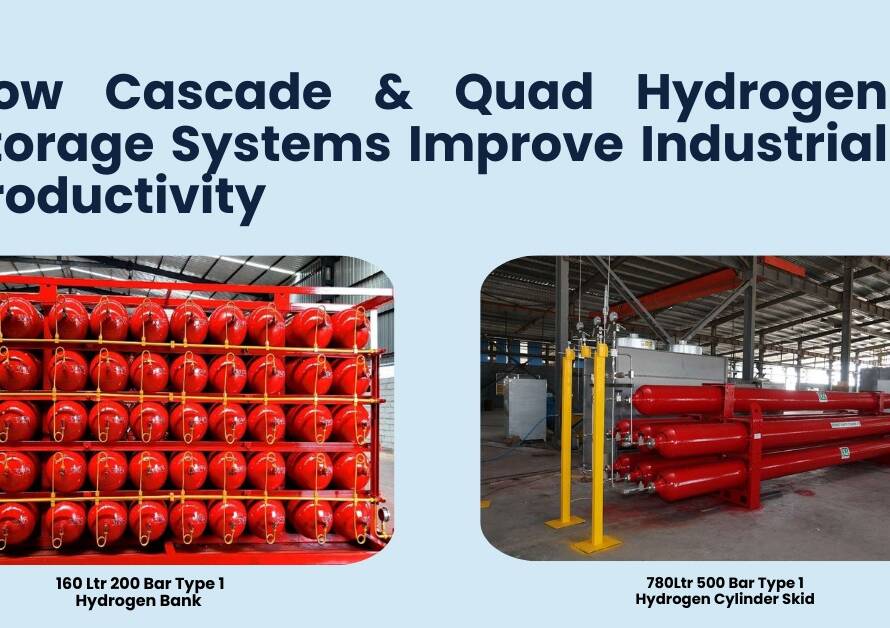
Once hydrogen is compressed, it needs to be stored before dispensing. High-pressure storage systems can use multiple cylinders or vessels arranged into storage banks.
Hydrogen storage technologies include:
- Type I cylinders
- Type II cylinders
- Type III composite cylinders
- Type IV composite cylinders
- Cascade storage systems
India’s hydrogen standards framework covers storage and transportation technologies alongside mobility and general safety requirements. The National Green Hydrogen Mission portal also lists standards for hydrogen storage, transportable cylinders, piping, and related infrastructure.
Understanding Cascade Storage
Cascade storage is particularly important for hydrogen refueling stations. Instead of storing all hydrogen at one pressure level, multiple storage banks can operate at different pressure levels.
A simplified arrangement is:
Low Pressure Bank → Medium Pressure Bank → High Pressure Bank → Dispenser
The station’s control system determines how hydrogen is transferred between storage banks and the vehicle. Cascade storage can help improve hydrogen utilization and support efficient vehicle refueling.
4. Pre-Cooling System
Hydrogen dispensing can cause the temperature of the gas and vehicle storage system to change significantly because of the rapid filling process. For high-pressure vehicle refueling, pre-cooling is therefore an important part of station design.
The cooling system helps control hydrogen temperature during dispensing and supports compliance with the required fueling conditions. This becomes especially important for high-throughput stations serving commercial fleets.
5. Hydrogen Dispenser
The dispenser is the part of the station that connects the hydrogen supply system to the vehicle. It performs several functions, including:
- Connecting to the vehicle
- Measuring hydrogen delivered
- Controlling the filling process
- Monitoring pressure and temperature
- Communicating with the vehicle system
- Safely stopping the filling process when require
For users, the dispenser is the most visible part of the hydrogen station—but behind it is a sophisticated network of compressors, storage vessels, valves, sensors, controls, and safety systems.
6. Hydrogen Refueling for Heavy-Duty Vehicles
Hydrogen refueling infrastructure could be particularly valuable for heavy-duty transportation. Trucks and buses often operate for long hours and cover significant distances. Their operational requirements can make rapid refueling an important consideration.
Potential applications include:
- Long-haul trucks
- City and intercity buses
- Mining vehicles
- Port vehicles
- Logistics fleets
- Industrial transport
- Commercial fleet vehicles
India has already sanctioned hydrogen mobility pilot projects involving hydrogen-fuelled vehicles and hydrogen refueling stations. Under Phase I of the NGHM transport pilots, five projects were sanctioned involving 37 hydrogen-fuelled vehicles (15 fuel cell and 22 hydrogen ICE) and 9 hydrogen refueling stations across 10 routes.
In Phase II, an additional 12 pilot projects have been awarded for deployment of 70 hydrogen-powered vehicles (27 buses and 43 trucks) along with 16 hydrogen refueling stations across 21 routes in different states.
7. Safety Systems
Safety is a fundamental requirement across every part of hydrogen refueling infrastructure. Hydrogen’s properties require specialized engineering, monitoring, ventilation, leak detection, pressure management, and emergency systems.
Important safety features include:
- Hydrogen leak detection
- Pressure relief devices
- Emergency shutdown systems
- Ventilation
- Gas monitoring
- Proper electrical classification
- Controlled hydrogen venting
- Fire detection and protection
- Safe separation distance
India’s hydrogen standards framework covers production, storage and transportation, end-use applications, and general safety. The MNRE-supported standards assessment identified a substantial body of Indian and international standards relevant to the hydrogen value chain.
8. Digital Monitoring and Automation
Modern hydrogen refueling stations can use sensors and control systems to continuously monitor station performance. Data can be collected from:
- Compressors
- Storage vessels
- Valves
- Dispensers
- Temperature sensors
- Pressure sensors
- Leak detector
Advanced monitoring systems can help operators identify abnormal conditions, schedule preventive maintenance, and improve station availability. In the future, AI and digital twins could further enhance hydrogen station management by enabling predictive maintenance and real-time optimization.
Why India Needs Hydrogen Refueling Infrastructure
India’s hydrogen ecosystem cannot scale through production capacity alone. Hydrogen must be available where and when it is needed.
A well-developed refueling network can help:
Support Hydrogen Mobility
Reliable stations can encourage fleet operators to adopt hydrogen-powered vehicles.
Connect Hydrogen Production With Demand
Refueling infrastructure creates a link between hydrogen producers and transportation users.
Enable Long-Distance Routes
Strategically located stations can support hydrogen-powered vehicles operating across highways and industrial corridors.
Encourage Private Investment
A growing refueling network can create opportunities for equipment manufacturers, infrastructure developers, fleet operators, and hydrogen producers.
India’s Emerging Hydrogen Refueling Ecosystem
India’s National Green Hydrogen Mission includes mobility pilots and infrastructure development as part of its broader hydrogen strategy. The Mission also supports green hydrogen hubs, where production and utilization can be concentrated alongside the necessary infrastructure.
The official National Green Hydrogen Mission project database already lists hydrogen mobility projects in locations including Greater Noida, Gujarat, Kerala, Andhra Pradesh, Jharkhand, Odisha, Maharashtra, and Madhya Pradesh, demonstrating that India’s hydrogen mobility ecosystem is moving toward practical deployment.
Key Challenges
Despite its potential, hydrogen refueling infrastructure faces several challenges.
High Capital Costs
Compressors, high-pressure storage, dispensers, cooling systems, safety equipment, and control systems require significant investment.
Hydrogen Availability
A refueling station needs a reliable and economical source of hydrogen.
Low Initial Utilization
During the early stages of market development, stations may operate below full capacity until enough hydrogen vehicles are deployed.
Standards and Regulations
Consistent standards are essential for equipment compatibility, safety, and large-scale deployment. India is strengthening its standards framework under NGHM, covering storage, transport, dispensing, and safety.
Maintenance and Skilled Workforce
Hydrogen infrastructure requires specialized knowledge for installation, operation, inspection, and maintenance. India is addressing these areas through its standards, testing, R&D, and skill-development initiatives under the National Green Hydrogen Mission.
The Future of Hydrogen Refueling in India
India’s hydrogen refueling network is likely to evolve alongside the growth of hydrogen-powered transportation.
Future infrastructure could include:
- Dedicated hydrogen corridors
- Fleet-focused refueling stations
- Highway hydrogen stations
- Hydrogen hubs near industrial clusters
- Onsite renewable-powered hydrogen production
- Larger high-pressure storage systems
- Automated dispensing
- AI-based station monitoring
The development of hydrogen corridors could be particularly important for heavy-duty vehicles, where predictable routes and centralized fleet operations can make early infrastructure deployment more practical.
Conclusion
Hydrogen refueling infrastructure is a critical piece of India’s emerging green hydrogen economy. Storage, compression, cooling, and dispensing work together to deliver hydrogen safely and efficiently to vehicles.
While hydrogen production receives significant attention, the infrastructure required to move hydrogen from production facilities to end users will ultimately determine how effectively the technology can scale.
India’s National Green Hydrogen Mission is already supporting mobility pilots, hydrogen hubs, infrastructure development, standards, testing, and R&D.
As hydrogen-powered trucks, buses, and commercial fleets become more widespread, a reliable network of refueling stations will become increasingly important.