Introduction
India’s green hydrogen industry is entering an important phase of development. With increasing investments in green hydrogen production, mobility, industrial applications, and hydrogen refueling infrastructure, the ability to store, transport, and distribute hydrogen efficiently is becoming just as important as producing it.
One technology at the center of this infrastructure is hydrogen compression.
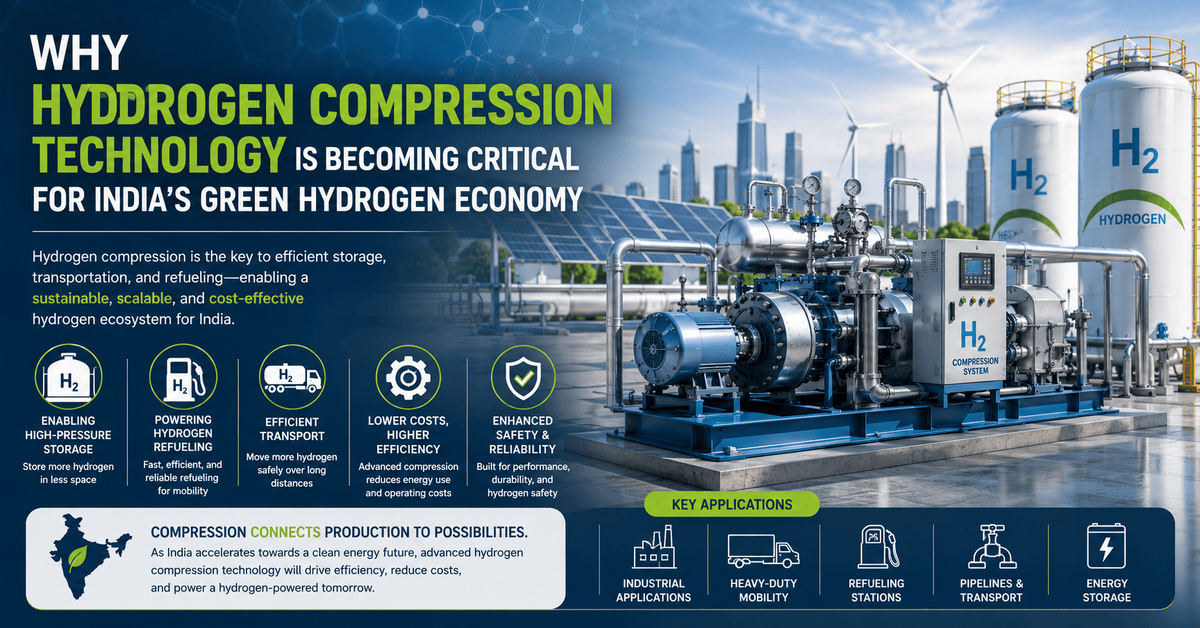
Hydrogen has a very low volumetric energy density under ambient conditions. Compressing it allows significantly more hydrogen to be stored and transported within a practical volume, making compression systems essential for applications such as high-pressure storage, hydrogen refueling stations, industrial gas supply, and mobility.
As India builds its hydrogen ecosystem, advances in compression technology could become critical for reducing costs, improving efficiency, and enabling large-scale deployment.
What Is Hydrogen Compression?
Hydrogen compression is the process of increasing the pressure of hydrogen gas so that it can be stored, transported, or dispensed efficiently.
Hydrogen can be compressed using different technologies, including:
- Reciprocating compressors
- Diaphragm compressors
- Piston compressors
- Ionic compressors
- Metal-hydride-based compression systems
- Electrochemical compressorseureka.
The appropriate technology depends on factors such as required pressure, flow rate, purity, operating conditions, and application. For example, hydrogen refueling stations may require high-pressure compression systems to fill vehicle storage tanks efficiently.
Why Hydrogen Compression Matters for India’s Green Hydrogen Economy
1. Enabling High-Pressure Hydrogen Storage
Storage is one of the biggest challenges in the hydrogen value chain. Compressed hydrogen can be stored in specialized systems such as:
- Type I cylinders
- Type II cylinders
- Type III cylinders
- Type IV composite cylinders
- Cascade storage systemspngrb.
High-pressure storage allows more hydrogen to be stored within a limited physical footprint. This is particularly important for industrial facilities and hydrogen refueling stations where space and operational efficiency matter.
2. Supporting Hydrogen Refueling Stations
Hydrogen mobility is expected to become an important application for green hydrogen, particularly for heavy-duty transportation.
Hydrogen-powered:
- Trucks
- Buses
- Commercial vehicles
- Long-distance fleets
may require rapid refueling to maintain operational efficiency. Compression systems are essential to move hydrogen from production or delivery systems into high-pressure storage and ultimately into vehicle tanks.
A reliable compression system can therefore become a critical component of India’s emerging hydrogen refueling infrastructure.
3. Improving Hydrogen Transportation
Hydrogen can be transported through pipelines, tube trailers, and other specialized systems. For gaseous hydrogen transportation, compression helps increase the quantity of hydrogen that can be moved within a given storage volume.
This can help improve:
- Transportation efficiency
- Logistics planning
- Storage utilization
- Supply reliabilityeureka.
As hydrogen production centers and consumption centers become increasingly connected, efficient compression will become more important.
4. Connecting Hydrogen Production With End Users
Green hydrogen production is often located where renewable energy is available, while demand may exist at industrial facilities, refueling stations, ports, and logistics hubs.
Compression provides the link between these parts of the hydrogen value chain. A typical system may follow this pathway:
Renewable Energy → Electrolyzer → Hydrogen Production → Compression → Storage → Transportation → End User
Efficient compression therefore supports the entire hydrogen supply chain.
5. Reducing Hydrogen Infrastructure Costs
Compression is an energy-intensive process, meaning compressor efficiency directly affects the economics of hydrogen. Advanced compression technologies can help reduce:
- Energy consumption
- Maintenance requirements
- Equipment downtime
- Operating costseureka.
Improving compressor efficiency can contribute to lowering the overall cost of delivered hydrogen.
Key Hydrogen Compression Technologies
1. Reciprocating Compressors
Reciprocating compressors use pistons to compress hydrogen gas. They are suitable for applications requiring high pressures and are widely used in industrial gas systems.
Advantages:
- High-pressure capability
- Proven technology
- Suitable for different flow requirementspngrb.
Challenges:
- Mechanical wear
- Maintenance requirements
- Pulsation and vibration
2. Diaphragm Compressors
Diaphragm compressors use a flexible diaphragm to compress gas without direct contact between the gas and conventional lubricated components. This can be particularly valuable where hydrogen purity is critical.
Advantages include:
- High gas purity
- Low contamination risk
- Suitable for high-pressure applications
They can be useful for hydrogen refueling and specialized industrial applications.
3. Ionic Compressors
Ionic compressors use an ionic liquid instead of conventional mechanical components to compress hydrogen.
Potential benefits include:
- Lower mechanical wear
- Reduced leakage
- High compression ratios
- Potentially improved efficiencyeureka.
As hydrogen infrastructure develops, such technologies may find wider applications.
4. Electrochemical Compressors
Electrochemical compression uses an electrochemical process to move hydrogen across a membrane while increasing its pressure.
These systems can offer:
- High hydrogen purity
- Low mechanical complexity
- Potentially efficient compression at certain scaleseureka.
They are particularly interesting for applications requiring high-purity hydrogen.
5. Metal-Hydride Compression (Optional Addition)
Metal-hydride hydrogen compressors use reversible absorption and desorption of hydrogen in metal alloys to achieve compression. Studies suggest they can offer lower operational costs over a 10-year lifecycle despite higher initial investment.
The Role of Compression in Hydrogen Refueling
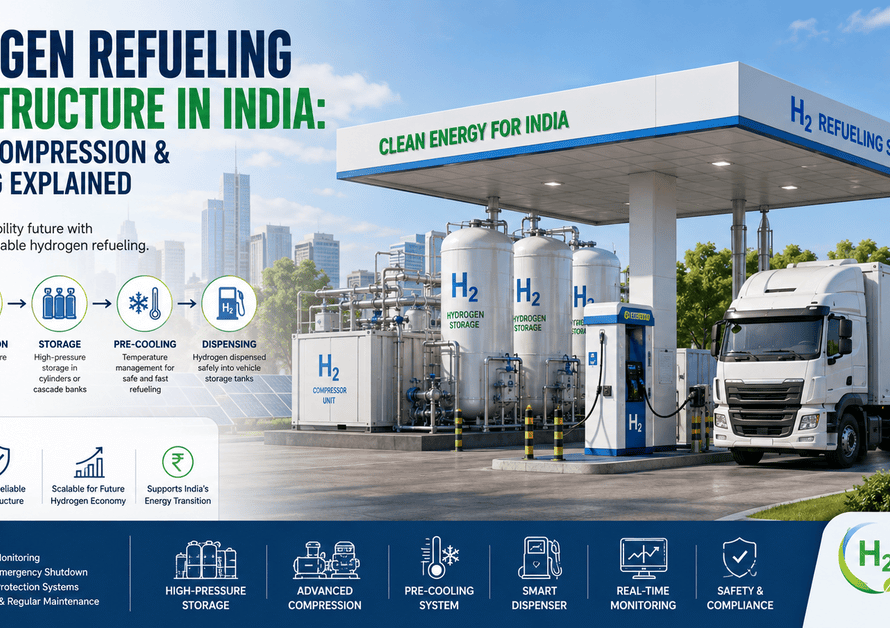
Hydrogen refueling stations require carefully designed compression and storage systems. A typical refueling station may include:
- Hydrogen supply
- Compressor
- High-pressure storage
- Cooling system
- Dispenser
- Vehicle storage
Before hydrogen enters a vehicle’s tank, it must be compressed to the appropriate pressure and managed under controlled temperature conditions. For heavy-duty mobility, reliable compression infrastructure will be essential for achieving fast and consistent refueling.
Compression and India’s Green Hydrogen Mission
India’s National Green Hydrogen Mission aims to establish a strong domestic green hydrogen ecosystem. The mission focuses on areas such as:
- Green hydrogen production
- Electrolyzer manufacturing
- Hydrogen mobility
- Industrial applications
- Infrastructure development
- Research and innovation
As these areas expand, compression technology will become an important supporting technology connecting hydrogen production with storage, transportation, and consumption.
Challenges Facing Hydrogen Compression in India
Despite its importance, hydrogen compression comes with several challenges.
High Energy Consumption
Compressing hydrogen requires energy. Poorly optimized systems can increase the overall cost of hydrogen production and delivery. Compression can consume 10–15% of the hydrogen’s energy content for 350 bar and up to 20–25% for 700 bar applications.
Equipment Costs
Advanced hydrogen compressors can involve significant capital investment. Current compression costs account for 15–30% of total hydrogen delivery expenses.
Hydrogen Leakage
Hydrogen molecules are extremely small and can escape through seals, joints, and connections if equipment is not properly designed and maintained. Leakage rates can exceed 3–5% in conventional compression systems.
Material Compatibility
Hydrogen can interact with certain materials and contribute to phenomena such as hydrogen embrittlement. Appropriate materials and engineering standards are therefore essential. Yield strength limits and specialized alloys are often required to prevent failures.
Maintenance
High-pressure hydrogen systems require specialized maintenance, monitoring, and safety procedures.
How Advanced Compression Technology Can Improve the Industry
Future compression systems are expected to focus on:
Higher Efficiency
Improved compressor designs can reduce the energy required for compression.
Higher Reliability
Advanced monitoring systems can detect abnormal conditions before failures occur.
Digital Monitoring
AI and digital technologies can monitor:
- Pressure
- Temperature
- Vibration
- Flow
- Compressor performance
This can support predictive maintenance and reduce downtime.
Modular Systems
Modular compression systems can allow hydrogen facilities to increase capacity as demand grows.
Hydrogen Compression and Heavy-Duty Mobility
Heavy-duty transportation is one of the areas where hydrogen could provide significant value. Long-haul trucks and buses require:
- High energy density
- Fast refueling
- Long driving ranges
- High vehicle utilization
Hydrogen compression technology can support these requirements by enabling rapid transfer of high-pressure hydrogen into vehicle storage systems. This makes compression infrastructure an important consideration in the development of India’s future hydrogen mobility corridors.
What the Future Holds
India’s hydrogen economy is still developing, but the infrastructure required to support it is becoming increasingly sophisticated.
Future developments may include:
- High-efficiency compressors
- AI-based compressor monitoring
- Automated pressure management
- Integrated compression and storage systems
- Hydrogen refueling corridors
- Large-scale hydrogen hubs
- Renewable-powered compression systems
The combination of advanced compressors, smart monitoring, and efficient storage could significantly improve the economics and reliability of India’s hydrogen supply chain.
Conclusion
Hydrogen compression technology is becoming a critical component of India’s green hydrogen economy because production alone is not enough. Hydrogen must also be compressed, stored, transported, and delivered efficiently before it can become a commercially viable energy carrier.
From high-pressure storage and industrial applications to hydrogen refueling stations and heavy-duty mobility, compression systems will support multiple stages of India’s emerging hydrogen ecosystem.
As India continues investing in green hydrogen production and infrastructure, advances in compression technology can help reduce energy consumption, improve reliability, enhance safety, and lower the overall cost of delivered hydrogen.
The future of India’s hydrogen economy will depend not only on how much hydrogen the country can produce, but also on how efficiently it can compress, store, move, and deliver it.