




Introduction
India’s green hydrogen industry is entering an important phase of development. With increasing investments in green hydrogen production, industrial applications, mobility, and hydrogen refueling infrastructure, the ability to store hydrogen safely and efficiently is becoming just as important as producing it.
Hydrogen has a very low volumetric energy density under ambient conditions. Storage systems allow hydrogen to be stored at suitable pressures, temperatures, or within specialized materials, making them essential for transportation, industrial supply, refueling stations, and energy applications.
As India develops its hydrogen ecosystem, advanced storage technologies can help improve supply reliability, support large-scale deployment, and connect hydrogen production with end users.
What Are Hydrogen Storage Systems?
Hydrogen storage systems are technologies and equipment used to store hydrogen safely until it is required for transportation, industrial use, refueling, or energy applications.
Hydrogen can be stored using different approaches, including:
- Compressed gaseous hydrogen
- Liquid hydrogen
- Metal hydrides
- Chemical hydrogen carriers
- Advanced composite storage systems
The appropriate technology depends on factors such as required capacity, pressure, application, available space, operating conditions, safety requirements, and cost.
Why Hydrogen Storage Matters for India’s Green Hydrogen Economy
1. Enabling Reliable Hydrogen Supply
Hydrogen production and consumption may not always occur at the same time or location. Storage allows hydrogen produced through electrolysis to be held until it is required, helping balance production and demand.
A typical hydrogen supply chain may follow:
Renewable Energy → Electrolyzer → Hydrogen Production → Compression → Storage → Transportation → End User
Storage therefore provides an important connection between hydrogen production and consumption.
2. Supporting Hydrogen Refueling Stations
Hydrogen mobility is emerging as an important application, particularly for heavy-duty transportation.
Hydrogen-powered:
- Trucks
- Buses
- Commercial vehicles
- Long-distance fleets
require reliable and efficient refueling infrastructure. A hydrogen refueling station may include hydrogen supply, compression, high-pressure storage, cooling, and dispensing systems. Storage provides the hydrogen buffer required for vehicle refueling.
India is already supporting hydrogen mobility pilots, including hydrogen-powered buses and trucks and multiple hydrogen refueling stations under the National Green Hydrogen Mission.
3. Improving Hydrogen Transportation
Hydrogen may need to be transported from production facilities to industrial plants, refueling stations, ports, and other consumption centers. For gaseous hydrogen, compressed storage systems can help increase the quantity transported within a practical volume.
Efficient storage can improve:
- Transportation efficiency
- Logistics planning
- Supply reliability
- Storage utilization
The National Green Hydrogen Mission also supports infrastructure involving pipelines, tankers, intermediate storage, and distribution networks.
4. Supporting Industrial Applications
Industries such as steel, refineries, chemicals, and fertilizers may become major consumers of green hydrogen. Storage systems can help industrial facilities maintain a reliable hydrogen supply and manage variations between production and consumption.
As green hydrogen moves toward larger commercial applications, reliable storage will become increasingly important.
Key Hydrogen Storage Technologies
1. Compressed Hydrogen Storage
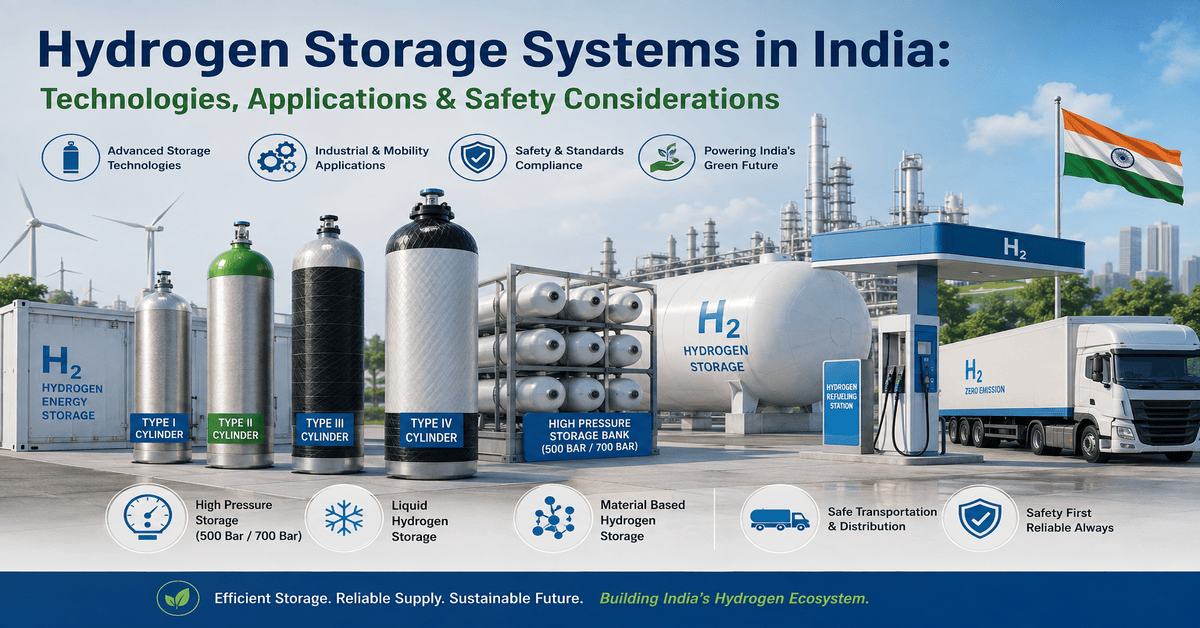
Compressed gaseous hydrogen storage is one of the most important storage technologies for hydrogen infrastructure. Hydrogen is compressed to high pressure and stored in specially designed cylinders, vessels, or storage banks.
Common storage systems include:
- Type I cylinders
- Type II cylinders
- Type III cylinders
- Type IV cylinders
- High-pressure storage banks
- Cascade storage systems
Compressed storage is suitable for industrial applications, hydrogen refueling stations, and mobility infrastructure.
2. Type III and Type IV Composite Cylinders
Type III cylinders use a metallic liner with extensive composite reinforcement, while Type IV cylinders use a polymer liner with a composite structure. These advanced cylinders offer significant weight advantages compared with conventional metallic vessels and are particularly relevant for high-pressure hydrogen mobility applications.
India’s hydrogen R&D roadmap includes the indigenous development and manufacturing of composite cylinders, including Type III and Type IV systems for hydrogen storage.
3. 500 Bar and 700 Bar Hydrogen Storage
High-pressure storage allows more hydrogen to be stored within a limited footprint. 500 bar systems can be useful for industrial storage and hydrogen infrastructure, while 700 bar systems are particularly important for applications requiring high storage density and lightweight vessels, especially mobility.
India is also moving toward domestic 700-bar storage technology. In April 2026, the Technology Development Board (TDB), Department of Science and Technology, signed an agreement with Gudlyf Mobility to support the development and commercialization of indigenous 700-bar composite hydrogen storage systems using Type IV and Type V technologies.
4. Liquid Hydrogen Storage
Hydrogen can also be stored in liquid form at extremely low temperatures. Liquid hydrogen can provide high volumetric storage density, but it requires specialized cryogenic tanks, insulation, and temperature management systems.
Because liquefaction and cryogenic storage add complexity and energy requirements, liquid hydrogen is generally considered for applications where its specific advantages justify the additional infrastructure. India currently does not have standards defined exclusively for bulk storage of liquid hydrogen, which remains an area for future regulatory development.
5. Material-Based Hydrogen Storage
Hydrogen can also be stored using materials that absorb or chemically bind hydrogen.
Examples include:
- Metal hydrides
- Chemical hydrogen carriers
- Advanced hydrogen storage materials
These technologies are still developing but could become useful for applications requiring alternative approaches to conventional compressed or liquid storage.
Hydrogen Storage Applications in India
Hydrogen storage can support multiple parts of India’s emerging hydrogen ecosystem.
Hydrogen Refueling Stations
High-pressure storage provides the hydrogen inventory required for fast and reliable vehicle refueling.
Industrial Facilities
Storage can provide a stable hydrogen supply for steel, refining, chemicals, fertilizers, and other industrial applications.
Green Hydrogen Production Plants
Storage can help separate hydrogen production from immediate consumption, particularly when renewable electricity availability varies.
Hydrogen Mobility
Fuel-cell vehicles require high-pressure onboard hydrogen storage. Trucks and buses can benefit from fast refueling and long operating ranges.
Hydrogen Hubs
Large hydrogen hubs can integrate production, storage, transportation, and end-use applications. India’s National Green Hydrogen Mission supports the development of Green Hydrogen Hubs and associated infrastructure.
Hydrogen Storage Safety Considerations
Hydrogen storage requires careful engineering because hydrogen can be stored at high pressures or extremely low temperatures.
Important safety considerations include:
High-Pressure Management
Storage vessels, valves, fittings, and piping must be appropriately designed, tested, and maintained. Pressure relief systems are also important for managing abnormal pressure conditions.
Hydrogen Leakage
Hydrogen can escape through poorly designed or maintained seals, joints, and connections. Leak detection, ventilation, regular inspection, and appropriate system design are essential for reducing risks.
Material Compatibility
Hydrogen can interact with certain materials and contribute to phenomena such as hydrogen embrittlement under suitable conditions. Material selection is therefore an important part of hydrogen storage system design.
Fire and Ignition Control
Hydrogen is highly flammable, making ignition control an important part of storage facility design.
Monitoring and Maintenance
Storage systems can use sensors and monitoring equipment to track:
- Pressure
- Temperature
- Hydrogen concentration
- Flow
- Equipment condition
Regular inspection and preventive maintenance are essential for long-term reliability.
India is also strengthening cooperation around hydrogen standards and safety protocols, including safety considerations across production, storage, transportation, and end-use applications. In July 2025, India updated the Gas Cylinders Rules, 2016 (Third Amendment) to tighten hydrogen storage norms, requiring compliance with CGA PS-46 and mandatory ISO tests for hydrogen service cylinders.
Challenges Facing Hydrogen Storage in India
Despite rapid development, hydrogen storage still faces several challenges.
High Capital Costs
Advanced high-pressure and composite storage systems can require significant investment. Increasing domestic manufacturing can help reduce costs.
Space Requirements
Large quantities of compressed hydrogen require carefully planned storage layouts and appropriate safety distances.
Safety Requirements
Hydrogen storage requires specialized monitoring, maintenance, safety systems, and trained personnel.
Technology Development
Hydrogen compatibility, pressure cycling, vessel durability, and long-term performance remain important areas for continued research and development.
What the Future Holds
India’s hydrogen storage ecosystem is expected to become increasingly advanced as green hydrogen production and utilization expand.
Future developments may include:
- Advanced Type IV and Type V cylinders
- 500-bar and 700-bar storage systems
- Lightweight composite vessels
- Large-scale hydrogen storage
- Digital monitoring systems
- Automated safety systems
- Integrated compression and storage
- Hydrogen refueling corridors
- Green Hydrogen
India’s R&D roadmap specifically targets indigenous composite cylinder manufacturing and development of storage systems up to 700 bar, while recent government support for indigenous 700-bar composite vessels shows continued progress toward domestic high-pressure storage capabilities.
Conclusion
Hydrogen storage systems are becoming a critical component of India’s green hydrogen economy because producing hydrogen is only one part of the value chain. Hydrogen must also be stored, transported, distributed, and delivered safely and efficiently.
From compressed gas cylinders and high-pressure storage banks to liquid hydrogen and material-based technologies, different storage solutions can support different applications.
Hydrogen refueling stations, industrial facilities, green hydrogen plants, mobility applications, and hydrogen hubs will all require storage systems designed around their specific requirements.
As India continues investing in green hydrogen production and infrastructure, advances in storage technology can improve supply reliability, support new applications, and accelerate the development of a scalable hydrogen ecosystem.
The future of India’s hydrogen economy will depend not only on how much hydrogen the country can produce, but also on how efficiently it can store, transport, and deliver hydrogen safely.