




Introduction
As hydrogen continues to emerge as a clean and sustainable energy source, one of the biggest challenges remains its safe and efficient storage. Traditional methods like compressed gas (350-700 bar) and liquid hydrogen come with safety risks and energy inefficiencies.
This is where metal hydride storage solutions offer a promising alternative. By enabling hydrogen to be stored in a solid form, metal hydrides provide enhanced safety, better energy efficiency, and compact storage capabilities—making them a key technology for the future of hydrogen storage.
What is Metal Hydride Storage?
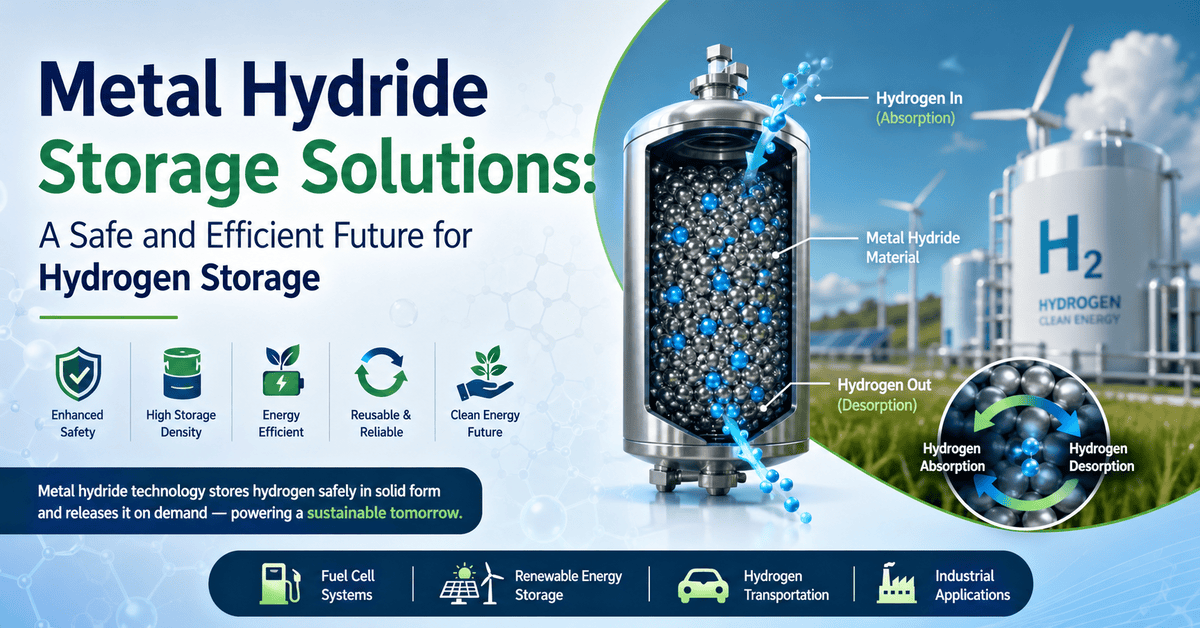
Metal hydride storage is a method of storing hydrogen by chemically bonding it with metals or metal alloys (often at 1-30 bar). When hydrogen gas interacts with certain materials, it forms a solid compound known as a metal hydride.
This process is reversible:
- Hydrogen is absorbed into the material for storage (exothermic).
- Hydrogen is released when needed by applying heat (endothermic).
Why Metal Hydride Storage is Important
- Enhanced Safety
Unlike compressed hydrogen, metal hydrides store hydrogen at low pressures (1-10 bar), significantly reducing the risk of leaks or explosions (up to 92% lower explosion risk). - High Storage Density
Metal hydrides can store a large amount of hydrogen in a compact space (high volumetric density), making them ideal for applications with space constraints. - Stable and Controlled Release
Hydrogen is released in a controlled manner, improving system reliability and safety.
How Metal Hydride Storage Works
- Hydrogen gas is introduced to the metal or alloy.
- The material absorbs hydrogen and forms a hydride.
- The hydrogen is stored in solid form within the material.
- When heat is applied, hydrogen is released for use.
This absorption-desorption cycle can be repeated multiple times.
Types of Metal Hydride Materials
- Intermetallic Compounds (e.g., AB5 like LaNi5H6, AB2)
Commonly used materials that offer good stability, moderate storage capacity (1.5-1.9 wt.%), fast kinetics, and low cost. - Complex Hydrides (e.g., NaAlH4, LiBH4)
Provide higher storage capacity but may require higher temperatures (and catalysts) for hydrogen release. - Lightweight Hydrides (e.g., MgH2, CaH2)
Materials like magnesium-based hydrides that offer high (gravimetric) hydrogen density but come with technical challenges (high desorption temperatures).
Benefits of Metal Hydride Storage Solutions
- Improved Safety: Low-pressure storage reduces risks.
- Compact Design: High volumetric efficiency (up to 65% smaller footprint vs. compressed gas).
- Energy Efficiency: Lower losses compared to liquid hydrogen (LCOS $0.38-0.45/kWh).
- Reusability: Multiple absorption cycles.
- Environment-Friendly: Supports clean energy initiatives.
Applications of Metal Hydride Storage
- Fuel Cell Systems
Used in portable and stationary fuel cells for stable hydrogen supply. - Renewable Energy Storage
Stores excess energy generated from solar and wind sources. - Transportation
Emerging use in hydrogen-powered vehicles for safer storage (despite weight challenges). - Industrial Applications
Used in laboratories (purification) and industrial processes requiring controlled hydrogen supply.
Challenges of Metal Hydride Storage
- High cost of materials.
- Weight considerations for mobility applications (low gravimetric density).
- Kinetics: Slow hydrogen release/absorption in some materials.
- Need for thermal management systems (heat transfer key).
Future Trends in Metal Hydride Storage
- Development of advanced lightweight materials.
- Improved heat management systems.
- Integration with renewable energy systems and EVs.
- Cost reduction through material innovation (market growth 12.6% CAGR to 2033).
How to Choose the Right Metal Hydride Solution
Consider the following factors:
- Required storage capacity.
- Operating temperature and pressure.
- System weight and size.
- Application type (stationary vs mobile).
- Cost and maintenance requirements.
Conclusion
Metal hydride storage solutions represent a significant advancement in hydrogen storage technology. With their superior safety, compact design, and efficient hydrogen handling, they offer a viable alternative to traditional storage methods.
We provide advanced metal hydride storage solutions that help industries adopt safer, more efficient, and reliable hydrogen storage systems.
As research and innovation continue, metal hydrides are expected to play a crucial role in enabling a safe, efficient, and sustainable hydrogen economy.