




Introduction
Hydrogen is becoming increasingly important across industrial manufacturing, chemical processing, energy storage, fuel cells, and emerging clean-energy applications. As hydrogen production and distribution expand, maintaining the right level of purity is essential for ensuring process efficiency, equipment reliability, and product quality.
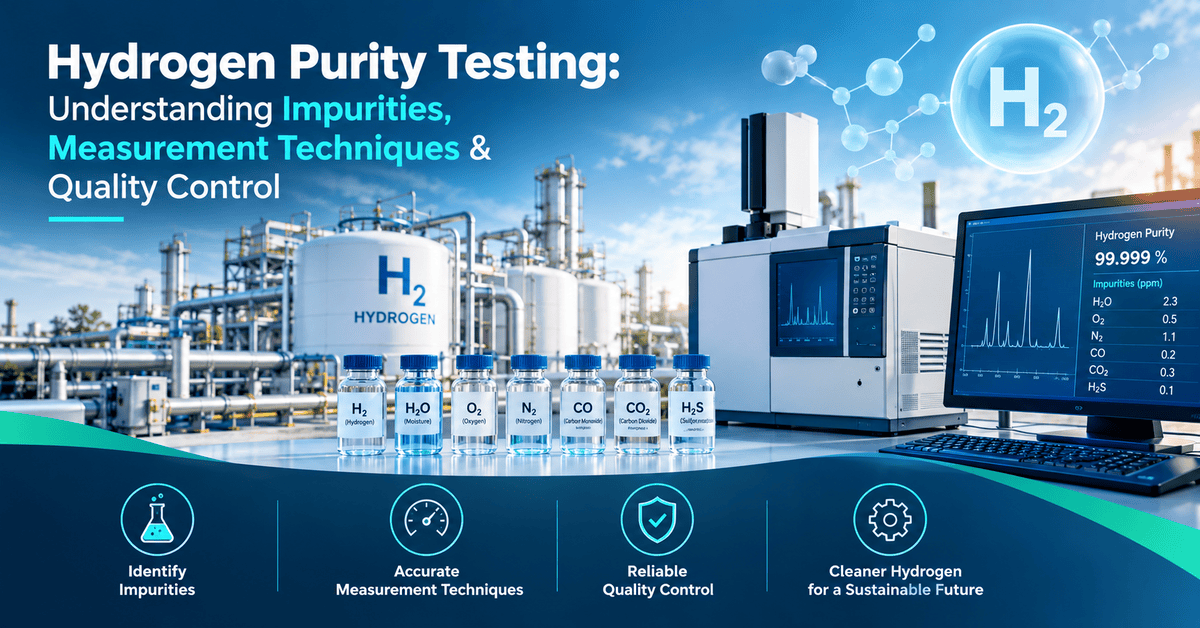
However, hydrogen produced through electrolysis, steam methane reforming, or other production methods may contain trace impurities. Depending on the production process, these can include moisture, oxygen, nitrogen, carbon monoxide, carbon dioxide, sulfur compounds, and other contaminants.
Even at very low concentrations, certain impurities can affect downstream processes, damage sensitive equipment, or reduce fuel-cell performance. This makes hydrogen purity testing, accurate gas analysis, and consistent quality control essential throughout the hydrogen value chain.
Understanding which impurities are present, how they are measured, and how results are evaluated helps operators deliver hydrogen that meets the requirements of its intended application.
Why Hydrogen Purity Matters
Hydrogen purity refers to the proportion of hydrogen in a gas stream and the concentration of other substances present. The required purity depends on the intended application, the applicable specification, and the limits for individual contaminants.
For example, hydrogen used in some industrial processes may have different quality requirements from hydrogen supplied to proton-exchange-membrane fuel cells.
Maintaining appropriate hydrogen purity helps to:
- Protect sensitive catalysts and fuel-cell components from contamination.
- Improve process consistency and operational reliability.
- Identify contamination introduced during production, compression, storage, or transportation.
- Support compliance with applicable hydrogen-quality specifications.
- Reduce the risk of product rejection, equipment issues, and unplanned downtime.
Purity is not determined by hydrogen concentration alone. A gas sample may contain a very high percentage of hydrogen and still exceed the permitted limit for a particular contaminant. Therefore, measuring individual impurities is often just as important as confirming overall hydrogen concentration.
Common Impurities in Hydrogen
The type and concentration of impurities depend on the production technology, purification process, storage conditions, and gas-handling equipment.
Moisture and Water Vapour
Moisture may enter hydrogen during production, drying, compression, or handling. Excessive water vapour can affect processes that require tightly controlled gas quality and may contribute to condensation or corrosion under suitable conditions.
Moisture analysers are used to measure water content, commonly expressed in parts per million, or to determine a dew point under specified conditions.
Oxygen
Oxygen may be present due to incomplete separation during electrolysis, air ingress, or leaks in gas-handling systems. Its presence can be particularly important where hydrogen quality and process safety require strict control.
Trace oxygen can be measured using suitable oxygen analysers selected for the expected concentration range and sample conditions.
Nitrogen and Other Inert Gases
Nitrogen and argon may enter the hydrogen stream through feed gases, process conditions, or contamination during handling. These gases can dilute hydrogen and may affect applications with strict composition requirements.
Gas chromatographs and other validated analytical methods can be used to quantify these components.
Carbon Monoxide and Carbon Dioxide
These contaminants may be associated with hydrogen produced from hydrocarbon-based feedstocks or with certain process and purification conditions. Carbon monoxide is particularly important in fuel-cell applications because it can affect catalyst performance.
Appropriate gas chromatography, infrared-based methods, or other application-specific analysers may be used, depending on the contaminant and required detection limit.
Sulfur Compounds and Other Trace Contaminants
Sulfur-containing compounds and other trace substances may originate from feedstocks, process equipment, or contamination. Their significance depends on the intended use and the applicable hydrogen-quality specification.
A suitable testing programme must consider the contaminants reasonably expected from the production pathway rather than relying on a single general-purpose measurement.
Key Measurement Techniques
No single instrument can reliably measure every possible hydrogen impurity across all concentration ranges. The correct technique depends on the gas composition, required detection limit, sample pressure, response time, and applicable test method.
Gas Chromatography
Gas chromatography separates the components of a gas sample so that individual substances can be identified and quantified using suitable detectors.
It is commonly used for compositional analysis, including hydrogen and selected impurities such as nitrogen, oxygen, carbon monoxide, carbon dioxide, and other gases, depending on the configuration.
Key benefits:
- Analysis of multiple gas components.
- Quantitative measurement when appropriately calibrated.
- Flexibility through suitable column and detector configurations.
- Support for laboratory testing and selected online monitoring applications.
Gas chromatography is especially useful when a detailed picture of hydrogen composition is required.
Moisture Analysis
Moisture analysers measure water vapour in a gas stream. Depending on the instrument, measurement may use techniques such as chilled-mirror dew-point measurement, capacitive sensing, or other suitable technologies.
The selected analyser must provide adequate accuracy and measurement range for the specification being checked.
Moisture testing is important when hydrogen is used in applications that require controlled water content or when drying-system performance needs to be verified.
Oxygen Analysis
Oxygen analysers measure oxygen concentration in the hydrogen stream. Depending on the required range and application, technologies may include electrochemical, paramagnetic, or other suitable sensing methods.
Instrument selection should account for the expected oxygen concentration, hydrogen compatibility, response time, calibration requirements, and potential interference from other gases.
Trace-Impurity Analysis
Some applications require the measurement of contaminants at very low concentrations. Depending on the substance, appropriate methods may include gas chromatography with a suitable detector, specialised trace analysers, or validated laboratory techniques.
The analytical method must be capable of detecting and quantifying the impurity at the level required by the applicable specification. A method adequate for percent-level composition may not be suitable for trace-level contamination.
Online Gas Analysis
Online analysers continuously or periodically monitor hydrogen composition at selected points in a production or handling process.
When correctly integrated, online monitoring can help operators identify changes in gas quality, evaluate purification performance, and investigate abnormal process conditions. However, an online analyser only measures the components and concentration ranges for which it is designed.
For critical applications, online results may be complemented by laboratory testing and periodic independent verification.
Hydrogen Quality Standards
Hydrogen-quality requirements vary by application. A key international reference is ISO 14687, Hydrogen fuel quality — Product specification, which establishes minimum quality requirements for hydrogen fuel in specified applications.
The current edition is ISO 14687:2025, which covers hydrogen distributed for residential, commercial, industrial, vehicular, and stationary applications.
For PEM fuel-cell road-vehicle applications, ISO 19880-8:2024 specifies that hydrogen dispensed to PEM fuel-cell vehicles should comply with Grade D of ISO 14687.
When evaluating hydrogen purity, organisations should consider:
- The intended application and applicable product specification.
- The permitted concentration of each relevant impurity.
- The prescribed or validated sampling and analytical method.
- Measurement uncertainty and the analyser’s detection capability.
- Calibration status, traceability, and reporting requirements.
A high overall hydrogen percentage does not, by itself, demonstrate compliance with all quality requirements. Each relevant impurity must be assessed against the appropriate limit.
Hydrogen Sampling
Reliable analytical results depend on obtaining a representative sample. Even a highly accurate analyser can produce misleading results if the sampling system introduces contamination or changes the sample before measurement.
Common sampling challenges include:
- Moisture entering through unsuitable or poorly maintained sample lines.
- Air ingress through leaking fittings and connections.
- Contamination from regulators, valves, tubing, or other sample-contact materials.
- Pressure and temperature changes affecting sample delivery.
- Inadequate purging or incorrect sampling procedures.
To improve sampling reliability, operators should use materials and components compatible with the gas and application, inspect connections for leaks, follow validated purging procedures, and maintain the specified sample pressure and flow conditions.
Sampling procedures should also minimise exposure to ambient air and moisture. Where required, samples should be collected and transported using validated procedures that preserve their composition.
For hydrogen fuelling stations, ISO 19880-9:2024 outlines requirements for sampling at the dispenser, including safety requirements and sampling practices intended to support analysis against ISO 14687.
Quality Control Across the Value Chain
Hydrogen quality control should be implemented across the entire value chain rather than only at the final delivery point.
Production and Purification
Testing at suitable production stages can help identify impurities originating from the production process and evaluate the performance of purification and drying systems.
For electrolytic hydrogen, relevant checks may include moisture, oxygen, and other contaminants associated with the process and equipment. The exact test plan should reflect the technology and intended application.
Compression and Storage
Compressors, valves, seals, manifolds, and storage connections can introduce contamination or create opportunities for leaks. Quality checks after compression or storage may help identify changes that occur during handling.
Transportation and Delivery
Hydrogen may be transported through pipelines, tube trailers, cylinders, or cascade storage systems. Depending on the delivery arrangement, sampling at appropriate transfer or delivery points can help confirm that the supplied gas meets its specification.
Final Quality Verification
Before hydrogen is released for a critical application, test results should be compared with the relevant quality limits. Non-conforming material should be managed through established procedures, including investigation, corrective action, and retesting where appropriate.
A documented quality-control process helps improve traceability and supports more consistent supply.
Calibration, Validation, and Maintenance
Hydrogen purity testing requires more than installing an analyser. Instruments must remain suitable for their measurement task throughout their operating life.
A practical quality-assurance programme should include:
- Calibration: Use suitable certified reference gases or other traceable standards as required by the instrument and method.
- Performance verification: Check analyser response and confirm that it can measure the relevant concentration range.
- Maintenance: Follow manufacturer recommendations for sensors, sample lines, filters, regulators, and other components.
- Method validation: Confirm that the analytical method is appropriate for the gas matrix, target impurity, and required detection limit.
- Recordkeeping: Document calibration, maintenance, test conditions, results, and corrective actions.
- Periodic review: Reassess the testing programme when production processes, equipment, or application requirements change.
For PEM road-vehicle hydrogen, ISO 21087:2019 provides a validation protocol for analytical methods used to ensure hydrogen quality at distribution bases and refuelling stations. It also covers measurement uncertainty, sample-integrity recommendations, and analytical reporting.
Calibration intervals and verification procedures should be based on instrument guidance, applicable standards, operating conditions, and quality-system requirements.
Common Measurement Challenges
Several factors can affect the accuracy and interpretation of test results.
Selecting the wrong analyser
An instrument may not have a sufficiently low detection limit or may not be suitable for the specific impurity.
Ignoring sampling-system contamination
Moisture, air, or other substances can enter the sample before it reaches the analyser.
Using unsuitable calibration gases
Reference gases must be appropriate for the measurement range and method.
Overlooking measurement uncertainty
Results close to a specification limit require careful interpretation, taking account of the method’s uncertainty and applicable decision rules.
Testing too few impurities
Measuring hydrogen concentration alone may overlook contaminants that are critical to the intended application.
Addressing these challenges requires coordinated planning across sampling, instrumentation, calibration, testing, and quality management.
Choosing the Right Testing Solution
The best testing solution depends on the production process and the quality requirements of the end user. Before selecting equipment, organisations should establish:
- Which impurities must be measured.
- The concentration range and required detection limits for each impurity.
- Whether continuous monitoring, periodic testing, or laboratory analysis is needed.
- Required accuracy, response time, and reporting capability.
- Gas compatibility, sample pressure, temperature, and flow requirements.
- Applicable standards, calibration needs, and maintenance arrangements.
A combination of complementary measurement technologies may be needed to provide adequate coverage. For example, a gas chromatograph may provide multi-component analysis, while dedicated moisture and oxygen analysers monitor specific contaminants.
The final configuration should be established through a documented technical assessment and validated against the requirements of the application.
Conclusion
Hydrogen purity testing is a fundamental part of delivering reliable hydrogen for industrial processes, energy applications, and fuel-cell technologies. Understanding impurities such as moisture, oxygen, nitrogen, carbon monoxide, carbon dioxide, and trace contaminants helps organisations identify the measurements needed to maintain the required gas quality.
By combining suitable analytical techniques, representative sampling, calibrated instruments, and systematic quality control, hydrogen producers and users can improve confidence in their test results and identify potential contamination earlier.
As the hydrogen economy develops, accurate measurement and consistent quality assurance will remain essential for building a dependable hydrogen supply chain.
For organisations involved in hydrogen production, storage, distribution, and use, selecting the right purity-testing approach starts with understanding the application, identifying the relevant contaminants, and verifying compliance with the applicable quality specification.