



Introduction
Hydrogen is playing an increasingly important role in industrial applications, clean energy, and transportation. As hydrogen production and distribution infrastructure expands, safe storage has become a critical consideration for manufacturers, plant operators, and infrastructure developers.
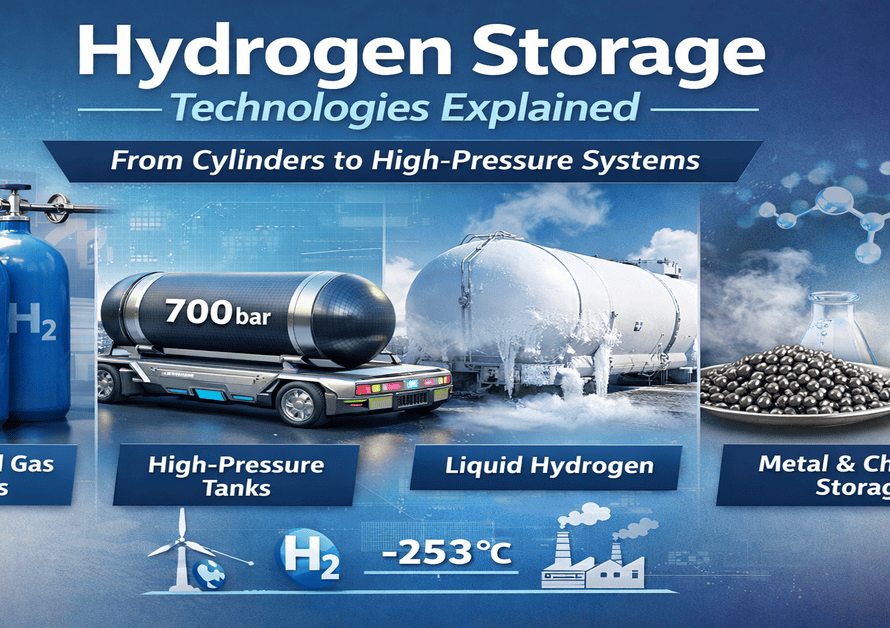
Hydrogen is commonly stored as a compressed gas in high-pressure cylinders, storage cascades, tube trailers, and other engineered storage systems. These systems must be designed and operated with appropriate pressure controls, inspection procedures, and safety measures to manage potential hazards.
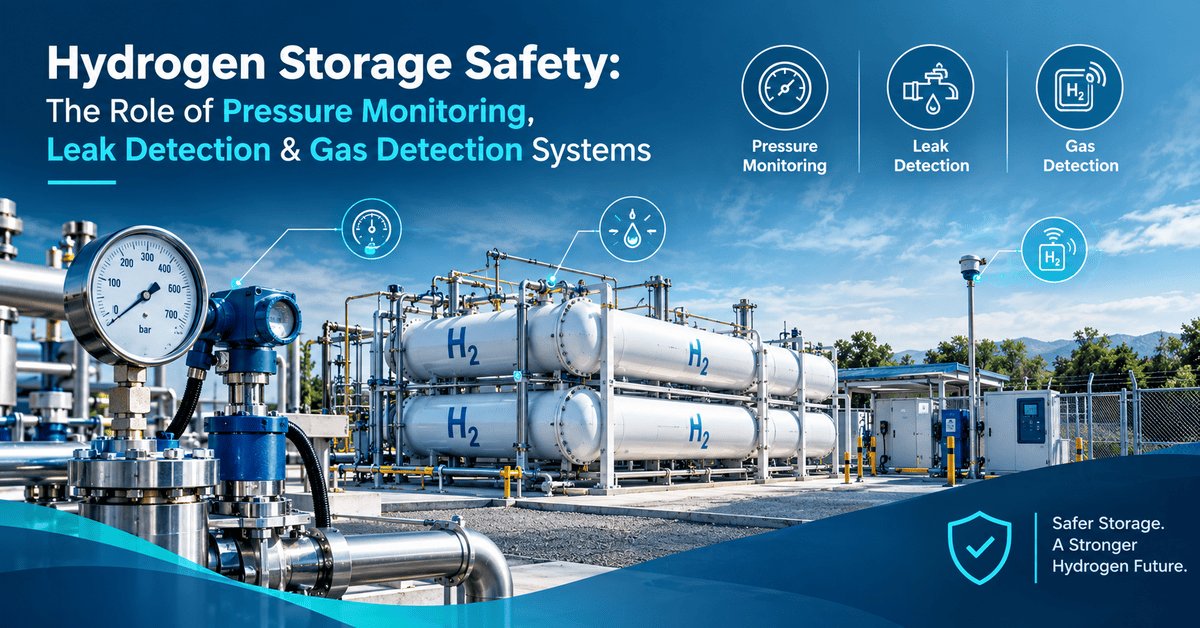
Pressure monitoring, hydrogen leak detection, and ambient gas detection systems are essential elements of a comprehensive hydrogen safety strategy. Together with sound engineering design, regular maintenance, ventilation, and emergency-response procedures, they help operators identify abnormal conditions and respond before a minor issue develops into a more serious incident.
Why Hydrogen Storage Safety Matters
Hydrogen has unique physical properties that influence how it must be stored and handled. It is a very light gas that disperses rapidly in many outdoor conditions, but it is also highly flammable and can ignite when mixed with air within its flammable range.
Hydrogen is colourless and odourless, so a leak cannot reliably be identified through sight or smell. Its small molecular size also makes leak-tight connections, compatible materials, and suitable inspection procedures particularly important.
Common hydrogen storage safety considerations include:
- Excessive pressure or unexpected pressure changes.
- Leakage from valves, fittings, seals, and connections.
- Material compatibility and potential hydrogen embrittlement.
- Equipment damage, corrosion, or deterioration.
- Inadequate ventilation or poorly positioned gas detectors.
- Failure of alarms, instrumentation, or emergency shutdown systems.
Managing these risks requires a combination of preventive engineering measures and continuous or periodic monitoring appropriate to the installation.
Pressure Monitoring
Hydrogen storage systems can operate at high pressures, making pressure monitoring an important part of safe operation. Compressed gaseous hydrogen storage commonly uses pressure levels such as 350 bar and 700 bar in mobility applications, while industrial storage systems may use other pressure ratings depending on their design and intended use.
Pressure monitoring helps operators verify that a system is operating within its approved limits and identify unexpected changes that may require investigation.
How Pressure Monitoring Supports Safety
Real-time pressure measurement: Pressure transmitters and gauges provide information about operating conditions inside cylinders, cascades, pipelines, and associated equipment.
Overpressure protection: Pressure monitoring can support alarms and protective controls when pressure approaches defined limits. Properly engineered pressure-relief devices provide a separate protective function and must not be replaced by monitoring alone.
Abnormal pressure identification: Unexpected pressure changes can indicate a process disturbance, a supply or demand imbalance, a control issue, or a potential leak. Pressure readings alone, however, cannot confirm the cause.
Filling and transfer control: Monitoring during filling and transfer operations helps ensure that approved operating procedures and equipment limits are followed.
Key considerations
A suitable monitoring arrangement should consider the operating-pressure range, instrument accuracy, response time, calibration requirements, hydrogen compatibility, and the consequences of instrument failure.
Where necessary, independent protective devices and automatic shutdown functions should be designed using an appropriate hazard assessment rather than relying on a single pressure reading.
Hydrogen Leak Detection
Leak detection helps identify hydrogen escaping from equipment or connections before the released gas creates a hazardous condition.
Potential leak points include:
- Cylinder valves and manifolds.
- High-pressure fittings and pipe connections.
- Regulators and pressure-control equipment.
- Compressor seals and associated components.
- Flexible hoses and transfer connections.
- Pressure-relief devices and dispensing equipment.
Leak detection may involve fixed hydrogen sensors, portable instruments, approved leak-testing methods, or a combination of approaches.
Why early leak detection matters
Hydrogen can disperse quickly in open, well-ventilated environments, but it may accumulate in enclosed spaces, roof pockets, or poorly ventilated areas. Actual dispersion depends on the release conditions, enclosure geometry, ventilation, and airflow.
An appropriately designed leak-detection system can provide early warning and initiate predefined responses, such as activating alarms, isolating equipment, or stopping hydrogen flow.
Detection coverage should be based on a site-specific risk assessment. Sensor placement must account for likely leak locations, hydrogen movement, ventilation patterns, and possible obstructions.
Important: A leak detector is not a substitute for sound piping design, suitable materials, pressure testing, maintenance, or safe operating procedures.
Gas Detection Systems
Hydrogen gas detection systems are designed to identify hydrogen concentrations in the surrounding atmosphere. They are different from gas-quality analyzers, which measure the composition or purity of a hydrogen stream.
Fixed gas detectors can be integrated with alarm panels, control systems, ventilation controls, and emergency shutdown systems, depending on the facility’s safety design.
Essential components
- Hydrogen sensors: Detect hydrogen concentrations within the specified measurement range.
- Detection and control panel: Receives sensor signals and evaluates them against configured alarm thresholds.
- Audible and visual alarms: Warn personnel when predefined conditions are detected.
- Ventilation systems: Help control gas accumulation where ventilation is part of the engineered safety strategy.
- Emergency shutdown systems: Can isolate equipment or stop hydrogen flow when specified conditions are met, provided the functions have been appropriately designed and validated.
- Monitoring and records: Help operators review alarms, identify recurring issues, and plan inspection and maintenance activities.
Why detector placement matters
Hydrogen is much lighter than air and tends to rise when released into many ambient environments. However, detector placement should not be based on this property alone.
Engineers should consider enclosure design, roof geometry, ventilation, air currents, release direction, and the potential for gas to collect in specific locations. A poorly positioned detector may fail to identify a leak promptly.
Detector selection, placement, alarm thresholds, and testing intervals should be determined by competent professionals using applicable standards and site-specific risk assessments.
For stationary hydrogen-detection applications, ISO 26142:2010 defines performance requirements and test methods for hydrogen-detection apparatus. India’s standards framework includes IS 16253:2016, which is based on ISO 26142:2010.
Pressure Monitoring vs Leak Detection vs Gas Detection
Although these systems contribute to hydrogen safety, they perform different functions.
|
System |
Primary function |
Safety contribution |
|
Pressure monitoring |
Measures system pressure |
Identifies abnormal pressure conditions |
|
Leak detection |
Identifies unintended hydrogen releases |
Helps detect or locate leakage |
|
Ambient gas detection |
Measures hydrogen concentration in surrounding air |
Warns of a potentially hazardous atmosphere |
|
Pressure-relief devices |
Relieve pressure under defined conditions |
Provide protection against specified overpressure scenarios |
|
Emergency shutdown system |
Executes predefined protective actions |
Helps isolate equipment or stop flow during specified events |
No single system provides complete protection. A layered safety approach combines appropriate equipment design, monitoring, alarms, protective devices, maintenance, and trained personnel.
Integrating Monitoring Systems Into Hydrogen Storage Infrastructure
An effective hydrogen storage safety strategy considers the complete system, including storage vessels, manifolds, valves, pressure regulators, compressors, transfer lines, instrumentation, and control systems.
For example, a storage cascade may use pressure instruments to monitor operating conditions, hydrogen detectors to identify releases near higher-risk connections, and a control system to activate alarms or initiate a defined shutdown sequence.
The precise configuration depends on the storage design, operating pressure, installation environment, hydrogen quantity, and risk assessment.
A well-designed monitoring arrangement should address:
- Instrument compatibility with hydrogen service.
- Suitable pressure and temperature ratings.
- Appropriate sensor ranges and response characteristics.
- Alarm and shutdown logic.
- Power supply and system-failure responses.
- Calibration, functional testing, and maintenance.
- Documentation and emergency procedures.
Where safety functions are automated, the complete detection-to-action sequence should be tested to verify that alarms, interlocks, and shutdown functions operate as intended.
Maintenance, Calibration, and Periodic Inspection
Even well-designed safety systems can become unreliable if they are not properly maintained.
Pressure instruments may drift, sensors may become contaminated or degraded, and alarms or control-system connections may fail. Regular inspection and functional testing help identify these problems.
A maintenance programme should include:
- Inspection of valves, fittings, seals, and connections.
- Calibration or verification of pressure instruments.
- Functional testing of hydrogen detectors and alarm systems.
- Verification of emergency shutdown and interlock functions.
- Inspection for damage, deterioration, or material incompatibility.
- Maintenance records, fault reporting, and corrective actions.
- Periodic review of the site’s risk assessment and emergency procedures.
Inspection and testing intervals should follow manufacturer recommendations, applicable regulations, and the facility’s risk-based maintenance programme.
Hydrogen Storage Safety in India
India’s National Green Hydrogen Mission is supporting the development of hydrogen production, applications, and associated infrastructure. As projects expand across industrial uses, mobility, and hydrogen supply networks, reliable storage and monitoring practices will remain important.
In India, hydrogen storage and handling are regulated through the Petroleum and Explosives Safety Organisation (PESO). Hydrogen cylinders are covered under the Gas Cylinder Rules, 2016, while storage vessels may be covered under the Static and Mobile Pressure Vessels (Unfired) Rules, 2016. These frameworks require PESO approval, approved cylinder or vessel designs and materials, testing, safety distances, labelling, and maintenance practices.
Hydrogen storage infrastructure may include high-pressure cylinders, cylinder cascades, manifolds, tube trailers, and storage installations connected to compression and refuelling equipment.
Each application has different operating requirements. Selecting the right pressure instruments, leak detectors, and gas-detection arrangements requires consideration of the equipment design, operating conditions, applicable standards, and site-specific hazards.
For project developers and operators, safety should be incorporated from the planning and design stages rather than treated as a final installation step.
Choosing the Right Monitoring Solution
Before selecting monitoring equipment, operators and engineering teams should evaluate the following factors:
Operating pressure
Confirm that instruments and associated components are rated for the intended service.
Detection requirements
Define whether the application requires pressure measurement, local leak detection, ambient gas monitoring, or several complementary functions.
Installation environment
Assess indoor or outdoor conditions, ventilation, temperature, hazardous-area classification, and potential sensor exposure.
System integration
Determine how readings, alarms, and protective actions will interface with existing controls.
Reliability and maintenance
Consider calibration access, functional testing, sensor life, spare parts, and maintenance support.
Applicable standards
Verify the relevant Indian regulations, codes, and standards for the particular installation. NFPA 2, the Hydrogen Technologies Code, provides safeguards for the generation, installation, storage, piping, use, and handling of compressed gaseous hydrogen and cryogenic liquid hydrogen, but its applicability depends on the jurisdiction and project requirements.
Conclusion
Safe hydrogen storage depends on more than strong cylinders and high-quality equipment. It requires a coordinated approach to pressure control, leak prevention, gas detection, inspection, and emergency response.
Pressure monitoring helps identify abnormal operating conditions, leak detection supports the identification of unintended releases, and ambient gas detection warns of potentially hazardous hydrogen concentrations. When these measures are correctly selected, installed, tested, and maintained, they contribute to a more reliable hydrogen storage operation.
As India’s hydrogen ecosystem continues to develop, a layered, risk-based safety approach will be essential to supporting dependable hydrogen production, storage, transportation, and refuelling infrastructure.
For hydrogen project owners and operators, the priority is clear: combine appropriate engineering design with reliable monitoring, preventive maintenance, and well-defined emergency procedures to help protect people, equipment, and operations.