




Introduction
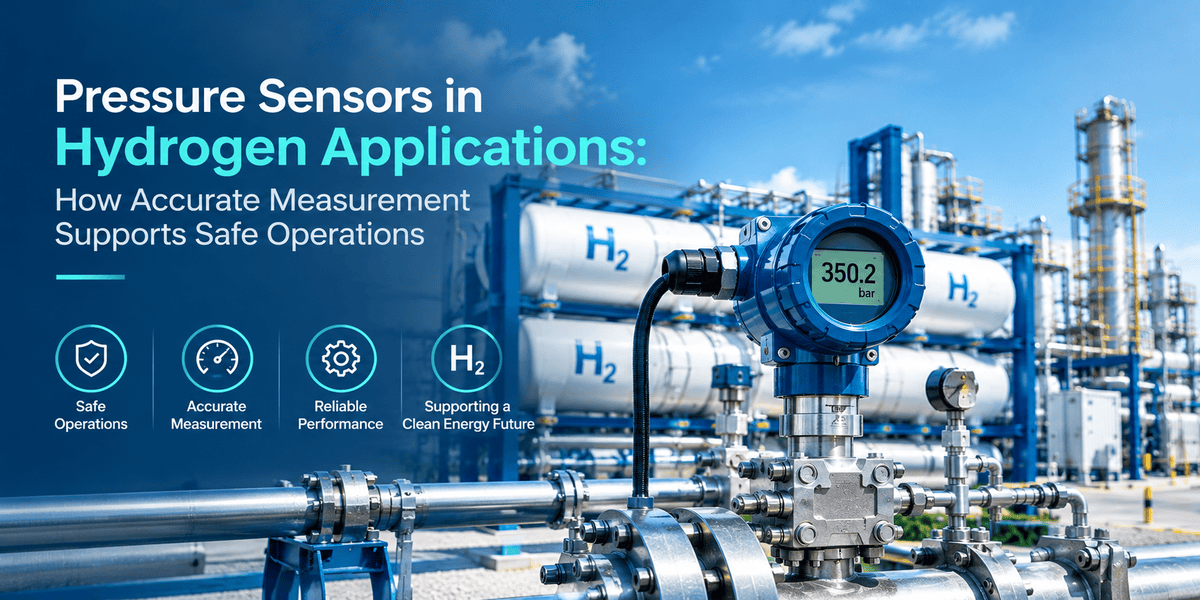
Hydrogen is becoming an increasingly important part of the global clean-energy transition. From green hydrogen production and industrial gas processing to high-pressure storage systems and hydrogen refuelling stations, reliable pressure measurement plays a critical role in maintaining safe and efficient operations.
Pressure sensors help operators monitor hydrogen pressure, identify abnormal operating conditions, and maintain process stability across different stages of the hydrogen value chain. However, hydrogen applications can present specific technical challenges, including high operating pressures, material compatibility concerns, and the need for dependable measurements over time.
Selecting the right pressure sensor and integrating it into an appropriate monitoring system can help industries improve operational reliability, support preventive maintenance, and strengthen process safety.
Why Pressure Measurement Matters
Pressure is one of the key parameters monitored throughout hydrogen production, compression, storage, transportation, and dispensing.
In an electrolyser, pressure measurement supports process monitoring. In a compressor, it helps operators assess suction and discharge pressure as well as system performance. In a cylinder cascade or hydrogen storage installation, pressure readings help track operating conditions during filling and withdrawal.
Accurate measurement helps operators:
- Monitor pressure against defined operating limits.
- Identify unusual pressure changes and potential process abnormalities.
- Support controlled filling, transfer, and dispensing operations.
- Monitor compressor and storage-system performance.
- Provide data for automation, alarms, and protective controls.
- Support maintenance planning and operational records.
Pressure measurement is not a substitute for pressure-relief devices, emergency shutdown systems, or other engineered safeguards. Instead, it provides important information that helps these systems operate as part of a coordinated safety strategy.
Key Applications Across the Hydrogen Value Chain
Hydrogen Production and Electrolysers
Green hydrogen production through electrolysis involves process conditions that must be monitored according to the equipment design. Pressure sensors can measure pressure at relevant process points, helping operators monitor system performance and identify deviations from established operating conditions.
The appropriate sensor depends on the process medium, pressure range, temperature, installation environment, and manufacturer requirements.
Hydrogen Compressors
Hydrogen compressors increase gas pressure for storage, transportation, or downstream applications. Monitoring suction, discharge, and other specified pressure points helps operators assess compressor performance and detect abnormal operating conditions.
Pressure data can also support maintenance strategies by helping identify recurring pressure fluctuations or changes in operating behaviour. In hydrogen refuelling stations, compressors are central to increasing hydrogen pressure for high-pressure storage and vehicle refuelling.
Storage Cylinders, Cascades, and Quads
Compressed hydrogen storage systems require pressure monitoring appropriate to their design and rated operating conditions.
Pressure sensors or transmitters can provide readings for monitoring systems, control panels, and operating personnel. In cylinder cascades and quad systems, these readings help operators understand storage conditions and manage transfer operations in accordance with approved procedures.
Sensor selection must account for the intended hydrogen service, maximum allowable pressure, material compatibility, and applicable safety requirements. Pressure instruments are commonly installed at valve manifolds, cylinder valves, gas-control panels, and supply systems.
Hydrogen Refuelling Stations
Hydrogen refuelling stations use high-pressure equipment and carefully controlled dispensing procedures. Pressure measurement supports monitoring of storage banks, compressors, and dispensing equipment at designated points.
Reliable pressure data helps control systems maintain specified operating conditions. The sensor’s pressure rating, response characteristics, and compatibility with the hydrogen environment must be suitable for the particular installation. Refuelling protocols also use pressure, flow, and temperature data to support safe dispensing.
Industrial Hydrogen Processes
Hydrogen is also used in chemical processing, refining, heat treatment, and other industrial applications. In these environments, pressure sensors support process control, equipment monitoring, and the maintenance of consistent operating conditions.
Accuracy, Repeatability, and Stability
Choosing a pressure sensor involves more than selecting a device with the correct pressure range. Its measurement performance must also suit the application.
Accuracy
Accuracy indicates how closely the measured value corresponds to the actual pressure under specified conditions. Suitable accuracy helps operators make reliable control and monitoring decisions.
Repeatability
Repeatability describes the sensor’s ability to produce consistent readings when the same conditions are repeated. Good repeatability is valuable when comparing process behaviour over time.
Long-Term Stability
Long-term stability refers to how well a sensor maintains its performance over an extended period. Measurement drift can affect control decisions and may increase the need for calibration or maintenance.
Response Time
Response time describes how quickly the sensor responds to a pressure change. The required response depends on the process dynamics and the function of the monitoring or control system.
Measurement Range
The sensor’s specified operating range must accommodate expected normal pressures and relevant operating conditions without exceeding its ratings.
It is important to evaluate these characteristics together. A sensor that performs well under laboratory conditions may not deliver the same performance if exposed to unsuitable temperatures, vibration, pressure cycling, or incompatible process conditions.
Hydrogen Compatibility
Hydrogen service creates material-selection challenges that must be considered when choosing pressure-measurement equipment.
Depending on the material, pressure, temperature, and operating conditions, hydrogen exposure can contribute to permeation or degradation of mechanical properties. Sensor diaphragms, wetted components, seals, and connections therefore require careful evaluation.
Wetted-material compatibility
Confirm that materials exposed to hydrogen are suitable for the intended service. Materials commonly considered for hydrogen applications include austenitic stainless steels such as 316L or 316Ti, as well as certain nickel-based alloys such as Hastelloy C276 and Inconel 718, subject to the manufacturer’s qualification and application requirements.
Diaphragm design
Evaluate the sensing diaphragm and any protective coating or barrier for the application’s hydrogen exposure and pressure conditions. Some hydrogen-rated sensors use gold-coated metallic membranes to reduce hydrogen permeation and associated signal drift.
Seals and connections
Ensure that the selected seals, fittings, and connection design are appropriate for hydrogen service and the specified operating conditions. At high pressures, metal-to-metal seals are often preferred where appropriate because elastomeric seals may have limitations in hydrogen service.
Pressure rating
Verify that the sensor and its installation are rated for the maximum expected pressure and relevant pressure cycles. In refuelling applications, sensors may need to accommodate pressures above the nominal vehicle-storage pressure because of temperature effects and safety margins.
Temperature range
Check performance and compatibility across the expected operating temperatures.
Installation environment
Consider vibration, moisture, electrical requirements, and hazardous-area classification where applicable.
Material suitability should be supported by relevant manufacturer documentation, engineering assessment, and applicable standards. A material or sensor suitable for one hydrogen application should not automatically be assumed suitable for every pressure and temperature range.
Pressure Monitoring and Process Safety
Pressure sensors contribute to safe operations by providing information that monitoring and control systems can use to identify abnormal conditions.
An unexpected pressure increase may indicate a process restriction, control issue, or another operating abnormality. A pressure decrease may be associated with a change in demand, equipment behaviour, or a potential leak. These readings are indicators for investigation rather than definitive proof of a specific fault.
When appropriately designed, pressure monitoring systems can support:
- Alarm generation: Alerting operators when measured pressure reaches predefined thresholds.
- Process control: Providing input to controllers that regulate pressure within approved operating limits.
- Protective actions: Supplying signals to safety-related systems where the sensor and control architecture are designed and qualified for that function.
- Trend analysis: Helping maintenance teams identify recurring fluctuations and changes in equipment performance.
- Operational records: Supporting reviews, troubleshooting, and maintenance documentation.
The sensor alone does not make an installation safe. Alarm thresholds, protective actions, redundancy, and failure responses must be established through the system’s engineering and risk assessment.
Calibration and Maintenance
Even a well-selected pressure sensor can become less reliable if it is poorly installed, damaged, or not maintained.
Calibration and inspection programmes help verify that pressure readings remain within the required performance limits.
A practical maintenance programme should consider:
- Calibration checks: Verify the sensor against an appropriate reference at defined intervals.
- Inspection of connections: Examine fittings, seals, mounting points, and process connections for damage or deterioration.
- Signal verification: Confirm that displayed values, transmitted signals, alarms, and control-system readings correspond as intended.
- Operating history: Review pressure trends and investigate unexplained deviations.
- Environmental checks: Confirm that vibration, temperature, moisture, and electrical conditions remain within specified limits.
- Post-maintenance verification: Check the measurement loop after sensor replacement, repair, or relevant system modification.
Calibration frequency should be determined by manufacturer recommendations, application criticality, operating history, regulatory requirements, and the consequences of measurement error.
For hydrogen installations, inspection and maintenance activities must follow approved procedures that address the hazards of the specific system.
Digital Monitoring Integration
Modern industrial facilities can integrate pressure transmitters with programmable logic controllers (PLCs), supervisory control and data acquisition (SCADA) systems, and industrial monitoring platforms.
This integration can make pressure information available to operators in real time and support more systematic process management.
Potential benefits include:
- Centralised monitoring of multiple pressure points.
- Configurable alarms for abnormal readings.
- Historical trend analysis and operational reporting.
- Better visibility into equipment behaviour.
- Data-supported maintenance planning.
- Integration with wider plant monitoring and control systems.
Digital integration must include appropriate signal validation, alarm management, cybersecurity controls, and responses to sensor or communication failure. Where a pressure measurement supports a safety function, the complete instrumented system must be designed and validated for that purpose.
How to Select the Right Pressure Sensor
Before selecting a pressure sensor, engineering and procurement teams should evaluate the complete operating environment rather than focusing on a single specification.
Key questions include:
- What is the normal operating pressure and maximum allowable pressure?
- What are the expected pressure fluctuations and cycling conditions?
- Is the sensor specifically suitable for the intended hydrogen service?
- Are the diaphragm, seals, and wetted components compatible with the application?
- What accuracy, repeatability, and response time are required?
- What are the operating temperature and environmental conditions?
- Does the installation require specific electrical or hazardous-area approvals?
- How will the sensor connect to the plant’s monitoring, control, or safety systems?
- What calibration, inspection, and maintenance support is available?
The final selection should be based on a documented engineering review and applicable regulations and standards.
Supporting the Hydrogen Economy
As hydrogen production, storage, industrial use, and refuelling infrastructure expand, reliable instrumentation will remain an important part of system design and operational management.
Pressure sensors provide essential measurement data, but their effectiveness depends on suitable product selection, hydrogen-compatible materials, correct installation, calibration, and integration with the wider control and protection architecture.
For manufacturers, system integrators, and hydrogen infrastructure operators, treating pressure measurement as part of the overall engineering strategy can help improve visibility into operating conditions and support dependable system performance.
Conclusion
Pressure sensors play an important role in hydrogen applications, from production and compression to storage, industrial processing, and refuelling. Accurate, stable, and application-appropriate measurements help operators monitor system conditions, identify deviations, and support informed operating decisions.
However, reliable performance requires more than measurement accuracy alone. Hydrogen compatibility, pressure ratings, installation quality, calibration, and integration with appropriate protective systems all contribute to dependable operation.
As the hydrogen ecosystem develops, carefully selected and properly maintained pressure-measurement solutions will continue to support safer, more controlled, and more reliable industrial operations.

